Author Archives: BIeditor

After years of criticism, FDA tries to step up oversight of medical devices

By Amy Martyn, CONSUMERAFFAIRS
October 27, 2016

Makers of medical devices face such little scrutiny from the Food and Drug Administration that even a 2011 Institute of Medicine report, commissioned by none other than the Food and Drug Administration, described the agency’s medical device evaluation process as “fatally flawed.”

Even worse, the FDA has reportedly allowed device-makers to flout the few regulations that they are supposed to follow.

Federal law requires pharmaceutical companies to report any injuries possibly related to medical devices within 30 days of learning about the so-called “adverse event.” But a Minneapolis Star-Tribune report, published last April, details how Medtronic, the world’s largest medical device company, waited years before telling the FDA about more than 1,000 adverse events related to one of its medical implants, Infuse. […]

In a lengthy statement, the FDA tells ConsumerAffairs that it had granted an exemption to Medtronic and defended the company’s actions.

“FDA’s allowance of a summary report in certain circumstances, under the relevant regulation, is both appropriate and in the best interests of the public health,” the statement says in part. “Such summary reporting can create practical efficiencies by reducing data entry and FDA staff review time of information that is already well-understood about a particular device.”

Asked to comment, Medtronic referred ConsumerAffairs to a statement the company published online. 

Multiple companies

A follow-up report published this month details how the FDA similarly accepted late adverse event reports from multiple companies, not just Medtronic, without penalizing the companies.
“When patients have been horribly harmed by medical devices, they’ve notified the FDA. But nothing changes,” Dr. Diana Zuckerman, President of the Center for Health Research, tells ConsumerAffairs. “And, the FDA has not penalized companies that failed to report serious complications to the FDA, as required by law. The FDA’s track record could hardly be worse.”

Zuckerman’s complaints aren’t new. In 2014, three years after the FDA’s Institute of Medicine panel called its regulatory process for devices flawed, Zuckerman lead a separate study claiming that there is scant public research to back up the safety of many FDA-approved medical devices. The agency has repeatedly contested such critical findings.

Criticism invited

But recent actions by the FDA now suggest the agency may finally be taking some of the criticisms of its device regulation to heart. On October 21, the FDA launched a new online program to encourage anyone, from patients to doctors, to report misconduct by medical device-makers.

“The webpage is not in response to any recent news articles,” FDA spokesman Stephanie Caccomo tells ConsumerAffairs via email. “The webpage was developed to provide the public with more information on allegations of regulatory misconduct related to medical devices and provide clear instructions for reporting to the FDA.” For public health watchdogs like Zuckerman, whether the FDA’s new program will have teeth remains to be seen.

The FDA’s new site, “Reporting Allegations of Regulatory Misconduct,”  specifically singles out medical devices and instructs people to report anonymously if they wish to do so. “Anyone may file a complaint reporting an allegation of regulatory misconduct,” the FDA says, with instructions on how to submit complaints via email or hard mail. […]

For watchdogs like Zuckerman, the FDA’s new site soliciting allegations of abuse in the medical device industry is an encouraging step, but only on paper for now.  Though the new policy “sounds great,” she says, “will it make a difference? Will the FDA finally stop treating device companies like their favorite customers and remember that patients and consumers are their most important customers? …More importantly, will FDA finally decide that they will no longer allow device companies to ignore patient safety?”

For the full article, click here. 

Does the FDA have a high enough standard for drug approvals?

BY SHAYLA LOVE, STAT NEWS

SEPTEMBER 28, 2016

[…]

Here are some excerpts of the conversation, edited for clarity.

Let me start off by asking: What do you think needs to be improved in the FDA approval process?

Zuckerman: I am increasingly concerned when the standards and criteria for what’s safe and what’s effective is moving more from the pre-market stage, before approval decisions are made, to the post-market stage. More drugs and devices are being approved on a basis of preliminary data, smaller samples, shorter time frames, and sometimes lacking control groups, as what recently happened with Duchenne muscular dystrophy. When that happens, it has a chilling effect on those who are trying to develop treatments and cures. Why would a company spend all of its energy working to do the best possible research if they can get an approval based on a shorter-term study, less definitive data, as long as they encourage patient groups to advocate and lobby for them?

What about the notion that patients and parents living with the disease are really the only ones who can understand what that’s like, and they should be in a position to assess the benefit and risk?

Zuckerman: I think patient perspectives absolutely should be factored in. And they should be factored in at every level. It’s not just important for patients who are wanting a treatment, it’s also equally important for the patients who get harmed. There are some folks in this room who have been harmed by unsafe medical products. They feel like FDA doesn’t listen to them. It’s really important to listen to patients, both the patients who can talk about the benefits of the drugs, or devices, but also the patients who can talk about the risks and the complications.

[…]

Going forward, why wouldn’t we be concerned that other companies won’t be emboldened to try and put an application in, and then force the issue? What we saw with this Duchenne episode is that when you have an effective pressure campaign, that can have an effect. And I’m not saying that’s necessarily a bad thing, that introduces a very human element into the discussion, and it can provide additional information.

[…]

Zuckerman: I want to get into the specifics of why this particular decision concerned us so much. The scientists all said this drug isn’t proven to work, we don’t know if it works, and therefore it doesn’t meet the legal standards that FDA is supposed to use to make a drug approval decision.

The company said they didn’t have a control group because it would be unethical to have a control group. That is a very frightening statement. If you think that it is not ethical to have a control group to study a drug that you don’t know whether it works or not, then you will never be able to find out if the drug works. You have to have a control group, particularly if you have a small sample like that.

Another big issue is the company announced the same day of the approval that this drug is going to cost $300,000 a year. This is a drug that has to be taken every year for the rest of these boy’s lives. It’s not a cure, it’s management. Now, these patients who have been getting this drug, presumably, for free as part of a clinical trial will somehow have to come up with $300,000 a year to continue to get the drug. I don’t know if insurance companies are going to pay for it, considering that the data show there’s not evidence that it works.

[…]

To see the original article, click here

Feds to crack down on those who fail to report clinical trials

By Brett Norman, Politico Pro
September 16, 2016

Drug companies and research institutions will have to publicly report more clinical trial data, including results that show their products or experiments failed, under new policies rolled out Friday by HHS.

The new rules address the fact that researchers have routinely flouted requirements to report data to ClinicalTrials.gov. A final rule from FDA and a complementary policy from NIH clarify which trials must be reported and project a new federal commitment to crack down on violators – threatening fines of $10,000 per day or disqualification from NIH funding.

The widespread failure by institutions to report the data is “simply unacceptable,” NIH Director Francis Collins said on a call with reporters.

“This is fundamentally an ethical issue,” FDA Commissioner Robert Califf said. “This is about maintaining the trust that we have with [clinical trial] participants … that if it doesn’t benefit them, it will benefit others.”

A 2014 review of the results of 400 clinical studies found that 30 percent had not been published or shared with ClinicalTrials.gov four years after they had been completed. A study earlier this year found that 43 percent of the trials conducted at 51 academic medical centers went unpublished two years after the trial was completed.

The new requirements, which will take effect in January, clarify that all NIH-funded studies must be published on ClinicalTrials.gov. The FDA will also require publication of studies being done on drugs and devices even if they have not yet been approved. Most studies must be reported within a year of completion, but those involving unapproved products could wait up to three years.

FDA and NIH are also expanding the range of information that must be published, including the demographic data on study participants, any adverse events and the original plan for statistical analysis. The latter is meant to combat so-called p-hacking – when the original hypothesis of an experiment fails and researchers massage the data to come up with some other positive finding that is statistically significant.

“We’ve had a problem where people do the trial and don’t like the result, so they do another analysis,” Califf said.

FDA and NIH decided not to require a lay summary of trial results that would enable the public – not trained in statistics – to more easily digest the information that is posted, angering some consumer advocates.

“That is an outrageous decision,” said Diana Zuckerman, president of the National Center for Health Research. “Without it, clinicaltrials.gov will not be providing useful information to patients.” The data won’t be useful to physicians either unless it is summarized, she said.

Collins and Califf said they had been uncertain how to keep “bias” from creeping into the summaries, adding that advocacy groups should be able to harness the relevant data and make it available in a way that would be more useful to patients. […]

To see the original article, click here

Crystal Hefner Removes Breast Implants, Says They ‘Slowly Poisoned’ Her

Chloe Tejada, The Huffington Post Canada
July 21, 2016

Talk about horrifying.

On Tuesday, Crystal Hefner posted an update to her social media accounts, revealing to her fans that she removed her breast implants after they caused several major health problems and bad side effects.

In the photo, posted on her Instagram and Facebook pages, the 30-year-old Playboy model — who’s been married to Hugh Hefner since 2012 — is seen lying convalescing on a hospital chair, wearing a blue gown, a robe and a towel resting on her forehead — an IV line attached to her hand.

 “My Breast Implants Slowly Poisoned Me,” she titled her post.

“Intolerance to foods and beverages, unexplained back pain, constant neck and shoulder pain, cognitive dysfunction (brain fog, memory loss), stunted hair growth, incapacitating fatigue, burning bladder pain, low immunity, recurring infections and problems with my thyroid and adrenals,” she wrote.

Hefner went on to explain that symptoms started a few years ago but she ignored them, despite the fact that she was not feeling well.

“The aches, the bladder pain, brain fog, fatigue. I ignored it, labeling myself a hypochondriac, despite truly worrying that there was something wrong with me. I joked about losing my memory to age, and about getting ‘lazy.'”

As the negative side effects worsened, her work as a model and DJ suffered.

“I began to cancel appointments and shoots because everything exhausted me,” she said. “I’ve had days in 2016 when I couldn’t get out of bed. I’ve felt such despair knowing life was happening all around me but I couldn’t participate… the fatigue was so severe that I could barely leave the house or drive. I was afraid to get up there in front of a crowd and go blank with brain fog.” […]

After announcing that she had been diagnosed with Lyme Disease and toxic mold, commenters said her symptoms were similar to the effects of those suffering from Breast Implant Illness.

She became a patient at The Lu-Jean Feng Clinic in Ohio, where, after discussing it with Dr. Lu-Jean Feng, she had her implants removed.

“Instantly I noticed my neck and shoulder pain was gone and I could breathe much better,” she wrote about how she felt after the surgery. “I know I won’t feel 100% overnight. My implants took 8 years to make me this sick, so I know it will take time to feel better. I also have other illnesses to address, but with the toxic bags removed, my immune system can focus on what it needs to.” […]

Here’s to wishing Crystal a safe, and healthy recovery.

Read the full article here. 

11 Ways Your Breasts Can Change in Your 20s & 30s

Carolyn Steber, Bustle
July 5, 2016

Breasts can be both a blessing and a curse. And regardless of their size or shape, breasts can change in your 20s and 30s to the point where you may be left stunned, annoyed, or even worried.

Of course, there are the usual monthly changes that many of us endure. “Premenstrual swelling and tenderness of both breasts occurs during the second half of the menstrual cycle,” according to an article from the U.S. National Library of Medicine. This means you might have that oh-so-familiar boob pain, on top of all your other PMS symptoms. You might even feel dense,bumpy areas on the outside of your breasts. These changes are likely due to varying levels of the hormones estrogen and progesterone, and often go away once your period arrives.

Again, this is all to be expected. But if you think back to the history of your breasts, you may notice there have been some other, more lasting, changes over the years. Maybe they’ve grown, or maybe they’ve shrunk. Maybe they have stretch marks, or maybe your nipples don’t look the same. It’s fascinating to watch all these changes take place, and yet it can leave you wondering if you’re the only one. (You probably aren’t.) Read on to find out other ways your boobs can change over the years, and remember — if anything is different, or worries you, definitely get yourself checked out by a doctor.

1. Your Areolae May Get Darker

It sounds kind of peculiar — an area of your body changing color. But it is definitely something that can happen to the area around your nipples over time. “It doesn’t necessarily happen to everyone, but … your areolae can start looking larger and darker than it did before, which is totally normal,” said Lane Moore, in an interview with Karen Boyle, M.D., on Cosmopolitan. It’s not cause for concern, but it can be pretty strange.

2. They Will Probably Fluctuate In Size

Breasts can fluctuate in size for a seemingly unending list of reasons. (Think about how they feel huge when you’re on your period, due to that influx of hormones I mentioned.) But another culprit affecting the size of your breasts is weight gain. “Your breasts are made up of breast tissue (including lobules and ducts that are called into action while breastfeeding) and fat tissue,” said Paige Fowler on SHAPE. “So when you gain weight, your breasts increase in size.” And the opposite is true for weight loss.

3. They Can Get Stretch Marks

As your breast size changes — due to weight gain, weight loss, or pregnancy — you may notice little lines starting to appear on your skin. These are stretch marks, and they can show up regardless of your age or skin color. “If you have gained weight recently, your breast stretch marks were likely caused by this,” said Richard Kalinowski on the health website Livestrong.com. “Even after losing excess weight, some evidence of the stretch marks will always remain, but they will become fainter and less noticeable.”

4. You May Find Lumps & Bumps

You should know how to do a breast cancer check, and you should do it regularly. This is a great way to catch cancer early on. But it’s also a great way to scare yourself with other, totally harmless, lumps and bumps. If you feel anything lurking under the surface of your skin, don’t panic — it’s likely nothing more than a benign cyst. “Fibrocystic change, which is a very common condition characterized by benign lumps in one or both breasts, often emerges when women are in their 20s,” said Zahra Barnes, in an interview with Lisa Jacobs, M.D., on Women’s Health. You should get them checked out, but they are usually nothing to worry about.

5. They’ll Be Less Full After Pregnancy

Your 20s and 30s are obviously prime baby making time, so changes brought on by pregnancy are worth noting. Of course you can expect to gain weight during pregnancy, and this will mean fuller breasts. You also may have lactation and breastfeeding to contend with, which can also affect the size of your boobs. But once that’s all over and done with, you may notice that things don’t necessarily go back to normal. “Breasts shrink, the fullness is gone, there is laxity in the skin and less tension on the suspensory ligaments,” said gynecologist Kevin M. Audlin, MD, in an interview with Aviva Patz onPrevention. This may mean droopier boobs, but hey — at least you got a baby out of the deal.

6. Your Nipples May Protrude

Another post-pregnancy milestone to expect is larger nipples, as well as darker areolas. And these changes can end up being permanent. Unlike your fuller pregnancy boobs, the darker areola color and protruding nipples may stick around, according to Patz. If you’re used to your nipples looking a certain way, it can be disconcerting. But I’m sure, with a new baby, that you have more important things on your mind.

7. They May Start To Droop

OK, “droop” is kind of a upsetting term, as it makes your boobs sound like a dying flower. So let’s say your boobs will start to “settle” in your 20s and 30s. “Having a baby, breastfeeding, and racking up more birthdays all contribute to a loss of elasticity of collagen, the connective tissue under the skin,” said Esther Crain on Women’s Health. “Sag can also be a matter of genetics.” So if your mom’s boobs “settled” early on, then your pair may do the same.

8. They May Be Worse For Wear After Exercise

Of course you should always get a healthy amount of exercise, regardless of how it affects your breasts. But so many 20- and 30-somethings hit the gym, that possible post-workout boob settling is worth mentioning. “The research is scant right now, but some experts say that the back-and-forth repetitive motions that happen when you run or do a similar workout can lead to a breakdown of breast collagen,” said Crain. It doesn’t mean you should quit the gym, but it may mean switching up your routine or wearing a better bra, if sagging is something you worry about.

9. Your Birth Control May Make Them Bigger

Birth control pills are obviously a miraculous invention. And yet they can cause all sorts of side effects, especially until you find the right one. Theseeffects may include weight gain, mood swings, and nausea, according to WebMD, as well as changes to your breasts. As Fowler said, “… it’s completely normal if you experience a little boost in breast size when you start birth control.” It’s all due to the increased estrogen, which can lead to fluid retention.

10. One May Be Larger Than The Other

Most breasts aren’t the same size. The causes are numerous, from misaligned posture, to hormones, to pregnancy. Other times, it may be due to those underlying fibroids, according to Arpana M. Naik, MD, on HealthyWomen.org. It’s totally normal, and nothing to be embarrassed about.

11. Your Boobs Become Something To Look After

The moment you get boobs, they become something to look after. As I said above, every lady should know how to do a self breast exam. If you find something concerning, make an appointment with your gynecologist, ASAP. But other than that, women in their 20s and 30s kind of get off easy when it comes to caring for their breasts. Mammograms aren’t really something you need to think about until you’re 50, according to Diana Zuckerman, Ph.D. and Anna E. Mazzucco, Ph.D. on StopCancerFund.org. If you have a family history of breast cancer, however, those scans may need to start earlier. Talk with your doctor about what’s right for you.

For the most part, being in your 20s and 30s means having healthy, happy boobs. But if any of the above changes occur, do bring it up with your doctor. It’s better to get things checked out, then to assume everything is a-OK.

Read the full article here.

Stephanie March Opens Up About Breast Augmentation Health Scare

Katie Kindelan, ABC News
June 30, 2016

Actress Stephanie March, best known for playing an assistant district attorney on “Law & Order: SVU,” has opened up about a dangerous reaction she experienced after undergoing breast augmentation.

March, 41, described the episode in a candid essay she wrote for Refinery29. The actress said she decided to have the surgery during a painful time in her life — her split from her then-husband, chef Bobby Flay. […]

March wrote that just two months after the surgery she experienced complications and learned her right implant was infected and the seams of her scar on her right side had burst. Her surgeon removed the implant and sent her to an infectious disease doctor.

“I [had] a hole in my breast for 6 weeks while I blasted my body with antibiotics. I had the implant put back in. I had another infection and rupture on Christmas Eve. I had it taken out again. I had more cultures and tests and conversations with doctors than I care to recall,” March wrote.

March said she came to the conclusion that her complication was not something anyone could have prevented but that, “I am allergic to implants. Plain and simple. My body did. Not. Want. Them. I kept trying to ‘fix’ my body, and it kept telling me to leave it alone.”

The actress, whose divorce from Flay was finalized in July 2015, ultimately had her implants removed. […]

March told ABC News in a statement she is “overwhelmed” and “very moved” by the “positive reaction” to her article.

Dr. Jennifer Ashton, ABC News Chief women’s health correspondent, said today on “Good Morning America” that even common plastic surgery procedures like breast augmentation are “not without complications.”

“You need to know about these possible complications and they do differ based on the type of implant used, the approach used, the incision and generally the skill and the expertise of the surgeon, although these can happen with the best surgical technique,” Ashton said, adding that March noted in her Refinery29 article she did not blame her own surgeon.

Ashton recommends that patients ask their doctor the following three questions before undergoing plastic surgery: Are you board-certified in plastic surgery? How many of these operations you do per year? What is your complication rate?

“If you think that having cosmetic surgery is going to change your life, it’s not,” Ashton added. “And there’s no such thing as minor surgery. You get a complication, it becomes major real fast.”

Read the full article here.

Janice Dickinson Regrets Getting Breast Implants, Believes It Affected Cancer Diagnosis

By Ali Venosa, Medical Daily
May 21, 2016

Breast implants are one of the most popular cosmetic procedures on the planet, but that doesn’t mean they’re never regretted. Supermodel Janice Dickinson, 61, told Entertainment Tonight that when her doctor told her she had stage 1 breast cancer, she wished she never went under the knife.

The mammogram technician added it’s more difficult to detect abnormalities in the breasts when a woman has implants, to which Dickinson replied, “Take them out! Take them out, cut them out! Just take them out now!” Luckily, she doesn’t need to undergo a mastectomy, and instead will begin radiation treatments next week. If she had to do it all over again, Dickinson said she “would have never gotten breast implants in the first place. […]

Though breast implants do not appear to increase a woman’s risk of breast cancer, there may be a link between implants and an increased risk of anaplastic large cell lymphoma (ALCL). In 90 percent of breast cancer cases, women find a breast lump themselves and bring it to the attention of their doctor. With implants, it can be a little more difficult to recognize changes in the breasts. According to one study, 55 percent of breast tumors were missed in women with implants compared to 33 percent of tumors in women without them. […]

For women worried that a mammogram will damage their implants, Bevers said not to worry: The benefits of a mammogram far outweigh any small risk of implant damage. But if women do have them, they should tell their clinician so that it’s easier for them to spot any unusual changes that may be taking place. Regardless of implants, though, the best defense against breast cancer is to be familiar with your breasts and to attend screenings regularly.

Overall, Dickinson herself doesn’t plan on slowing down. It’s not a “big pity party,” she said. “I am living and I am happy.”

Read the full article here

The above article was published in 2016.  In August 2014, the National Comprehensive Cancer Network (NCCN), a nonprofit alliance of leading cancer centers, provided guidelines for the diagnosis of “breast implant associated ALCL (BIA-ALCL), based on clear evidence that breast implants can cause ALCL.  In 2017, the World Health Organization (WHO) and the Food and Drug Administration (FDA) both issued statements confirming that breast implants can cause ALCL.  To read about the FDA’s 2017 report on breast implants and ALCL, click here (insert hyperlink to http://www.breastimplantinfo.org/implantalcl/)

Patient Advocacy Workshop 2016

Patient Advocates Wanted!

Researchers in government and at universities are listening to patients’ perspectives on the risks and benefits of treatments. They need to hear from patients like you! That’s why we are holding several free workshops for individuals who want to be advocates for patients. The Workshops will train patients and family members to understand research that evaluates the safety and effectiveness of treatments and prevention strategies, and teach them about opportunities to share their own views and perspectives in ways that will most benefit patients.

Most patient advocates help a small number of individual patients. Our goal is different. Our workshops and training are designed to help patient advocates get the information, skills, ad confidence they would need to help patients on a national level by influencing the development and evaluation of treatments used by patients across the country.

You might be surprised to learn that many studies of new treatments measure changes that do not necessarily improve patients’ health or quality of life. For example, it is faster and less expensive to study whether a cancer drug shrinks tumors than to study whether that same drug helps a patient live longer or have a better quality of life. Some patients might be fine with taking a chance on a drug that is not proven to help them live longer, because they have run out of options. Others only want to try a new drug if it is likely to help them live longer or have fewer side effects. Those kinds of patient perspectives are very important to researchers and to health professionals, and we will help patients have the expertise they need to share their views with researchers and opinion leaders.

Our next workshop will be held on Friday October 14 and Saturday October 15, 2016. The 2-day workshop will be free, and meals will also be included. Hotel rooms and travel scholarships to Washington, DC will be available for those who live at least 40 miles away.

Anyone can apply, but we are especially interested in adults who have previously been involved in patient advocacy, either as an individual or as a member, volunteer, or staff for a nonprofit organization or government agency.

Please complete our application at http://goo.gl/forms/CxFrg61Qk15pxvyw1. Preference will be given to applications received by July 31, 2016. And feel free to share with other patients who are well enough to advocate for themselves and others.

Make your voice heard! 

Find out more about this year’s Patient Advocacy Workshop HERE.

Capture

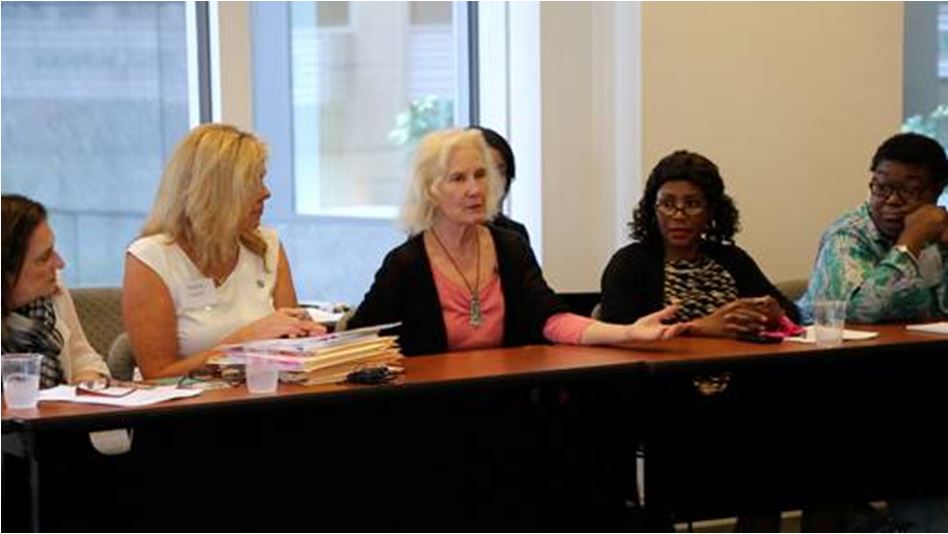
Patient advocate Diana Levine discusses her experiences, at the June 12, 2014 Workshop