Author Archives: BIeditor

Possible drug risks buried in delayed FDA ‘Watch Lists’

March 29, 2016
By Robert Lowes, Medscape Medical News

The US Food and Drug Administration (FDA) has an early warning system to help catch safety problems with drugs after they reach the market. In the second quarter of 2015, a class of diabetes drugs called SGLT-2 inhibitors showed up on its radar screen.

The public didn’t know about this blip until about 7 months later. By law, it should have known months earlier. FDA critics say the agency’s early warning system needs fixing.

The regulatory radar is built on the FDA Adverse Event Reporting System (FAERS), which receives reports of problems from physicians, nurses, pharmacists, patients and their family members, and attorneys as well as drug manufacturers who pass on complaints they get from the public.

[…]

To one public health expert, publication delays for the FAERS watch lists illustrate how the FDA caters more to drug manufacturers than patients.

“The FDA has many requirements, and Congress keeps passing legislation that adds more mandates without adding funds for staff,” said Diana Zuckerman, PhD, president of the National Center for Health Research, a think tank focused on children and adults. “In the last year, it has become more obvious that the requirements that FDA has as its first priority are the ones that benefit industry — faster approvals.”

The FDA is beholden to pharmaceutical companies, said Dr Zuckerman, because they pay user fees that partially fund the agency. These same companies lobby a Republican Congress for a quicker, less onerous review process, and Congress in turn pressures the FDA to speed things up.

The agency felt a different kind of pressure when GAO [Government Accountability Office, the federal watchdog agency] issued its report on January 14, and Congresswoman DeLauro immediately called the FDA’s data problems “a severe safety risk for American consumers.” Dr Zuckerman said it was no coincidence that roughly 3 weeks later, the FDA posted its FAERS watch lists for the first three quarters of 2015, followed by the fourth-quarter report on March 22.

The watch lists play an important role in patient care, she said.

“Doctors who know there is a possible adverse risk for a drug might be likely to report it themselves if they see it in their patients,” she said. “And they’d be more likely to consider alternatives.”

Likewise, said Dr Zuckerman, some patients may balk at taking a drug appearing on a watch list.

“It’s not that these safety signals mean ‘Never use this drug,’ ” she said. “But they’re warning signals. That’s the whole point.”

[…]

To see original article, click here.

Senate approves FDA’s ‘breakthrough pathway’ for medical devices

March 23, 2016
by Gail Kalinoski , Contributing Reporter, Health Care Business

A bipartisan Senate committee has approved three bills that could help get medical devices to patients sooner by creating a “breakthrough pathway” through the U.S. Food and Drug Administration, but not everyone is happy about the actions.

————————

Diana Zuckerman, president of the National Center for Health Research, wrote on behalf of the watchdog group that it was “concerned that the focus of these bills is on getting medical products to market more quickly, instead of making sure they are safe and effective.” The group’s letter added: “Whether creating a new breakthrough pathway for devices (which already are approved based on much lower standards than drugs) or deregulating health IT software, for example, patients will be at risk.”

The group said it strongly opposed one of the bills passed, the Medical Electronic Data Technology Enhancement for Consumers’ Health Act, (S. 1101) known as MEDTECH, stating it would remove “potentially lifesaving and life-threatening health IT software entirely from the FDA’s regulatory oversight, and could possibly eliminate recalls for IT devices with life-threatening flaws.”

But the Advanced Medical Technology Association (AdvaMed) applauded the bills approved earlier this month by the Senate’s Health, Education, Labor & Pensions (HELP) Committee.

[…]

AdvaMed also supported the HELP committee’s work on the Advancing Breakthrough Devices for Patients Act (S. 1077) and the Combination Product Regulatory Fairness Act (S. 1767).

“Taken together, these three bills will help improve patient access to some of the latest medical advancements and foster a more efficient, predictable and transparent review process within the FDA, all the while maintaining the agency’s strong standards for safety and effectiveness,” Scott stated.

Zuckerman’s group disagreed, once again opposing the bills for lowering standards and undermining or micromanaging the FDA. Her letter stated that the vague language on what classified a device as “breakthrough” may “encourage many device companies to apply for ‘breakthrough’ status, overwhelming the resources of the FDA.”

The National Center for Health Research also claimed that smaller clinical trials could compromise the majority of patients because they may have “fewer women, people of color and patients over 65 – often too few to ensure that the device is safe and effective for those groups.”

[…]

Read full article here.

Senate committee approves legislation to speed approval of medical devices

By Thomas M. Burton, The Wall Street Journal
March 9, 2016

WASHINGTON—A Senate committee Wednesday approved a slate of bills that would relax requirements for approval of medical devices by the Food and Drug Administration, part of a larger effort aimed at speeding up the regulatory process and boosting medical research.

Most of the measures were approved with bipartisan support, but there are indications of discord on the package. Some patient-safety advocates said the legislation would weaken the FDA’s ability to ensure the dependability and safety of medical devices.

[…]

At issue is how aggressively the FDA will regulate medical products. The “breakthrough” [products] bill, for example, would allow the use of shorter or smaller clinical studies and quicker measures of success, and medical-device safety experts have already expressed concern that the standards for device approval are significantly lower than those for drugs.

[…]

The “breakthrough” bill “sets a low bar to qualify for ‘breakthrough’ status’ ” and “lowers standards for safety and effectiveness,” said Diana Zuckerman, president of the National Center for Health Research in Washington, a medical research and advocacy group.

[]

“We are concerned that the focus of these bills is on getting medical products to market more quickly, instead of making sure that they are safe and effective,” Dr. Zuckerman wrote on behalf of her group and 13 other medical safety groups in a letter to the senators on the HELP committee.

To read the full article, click here.

FDA Aims To Speed Clinical Trials, Improve Device Safety Through Post-Market Evaluation, But Funding A Hurdle

February 16, 2016, Inside Health Policy

FDA’s device center chief Jeff Shuren, in an interview with Inside Health Policy, highlighted the benefit a robust National Device Evaluation System could have in bolstering the agency’s ability to monitor devices in real-time to better inform the risk-benefit profile of approved products. Such a system, he said, could also help in the premarket approval phase to reduce the clinical trial burden on manufacturers and get products to market faster.

The program is a high priority for the Center for Devices and Radiological Health within FDA. It was recently listed in CDRH’s 2016-2017 priority agenda, and FDA in the fiscal 2017 budget requested $1.8 million in funding to help establish the system as part of President Barack Obama’s Precision Medicine Initiative. The agency will hold a public workshop in March on the effort.

The goal for FDA, according to Shuren, is to move past the traditional scope of a national surveillance system and launch a program that would allow the agency to more accurately track and analyze the use of medical devices in a real-world setting and better understand the benefits and risks of specific products outside of the clinical trial setting.

[…]

Sources point to a lack of funding as a main reason for FDA’s inability to effectively monitor medical devices in the postmarket setting. Some stakeholders pointed to the disparity in user fees between the drug and device centers as a main reason for the lack of available resources, but others defended the amount of money the device industry currently provides as reflective of the gap in market caps between large manufacturers and smaller device start-ups.

Sources say industry is lukewarm on providing additional resources for postmarket in the pending user fee reauthorization agreement, which has led patient and consumer groups to turn their attention to Congress in the hopes that additional funding for the agency’s postmarket goals will be included in next year’s spending bill.

“I think more money is problem number one and without more money the agency is never going to do a good job,” Diana Zuckerman, president of the National Center for Health Research, told IHP.

Stakeholders have suggested the medical device user fee process is more difficult to navigate than the sister program in the drug center, given the financial disparity in the medical device industry between the large corporations and smaller start-ups. Zuckerman, however, argued that no one is expecting a small device company to pay millions in user fees to cover something like postmarket surveillance.

“There are many small companies and, yes, small companies should have user fees that are affordable, but the medium, large and extra-large sized device companies could be paying a lot more,” she said.

Johnson & Johnson, for example, pays roughly $2.4 million in user fees for a new drug application, sources say, and only $5,000 for a 510(k) submission. A spokesperson for J&J did not respond to inquiries.

Increasing the amount of user fees for the large companies, sources say, could help fund FDA’s postmarket surveillance goals. Sources familiar with the user fee discussions tell IHP, however, that the medical device industry, in particular the Advanced Medical Technology Association, has rejected the notion that industry should have to pay more for faster approvals.

[…]

To read the full article, click here.

2016 Update: When should women start regular mammograms? 40? 50? And how often is “regular”?

Diana Zuckerman, Ph.D. and Anna E. Mazzucco, Ph.D.
Updated 2016

In recent years, there has been a growing concern that annual mammograms starting at age 40 may do more harm than good for many women. That is why the U.S. Preventative Services Task Force, an expert group that reviews the latest research findings, recommends that mammography screening for most women start at age 50 rather than 40, and that the frequency be every two years (instead of annually) through the age of 74.

The Task Force is widely used as a gold standard for determining medical treatment and screening. In this case, they recommended raising the age to 50 after the American College of Physicians recommended the same thing, and they also recommended that women continue to undergo mammograms until age 74. They say that there is no evidence of what the benefits might be for women 75 and older.

For many years, the American Cancer Society (ACS) recommended annual mammograms starting at age 40, but in October 2015, they issued new recommendations that moved in the direction of those of the medical experts. They now recommend that women at average risk of breast cancer start mammography at 45, that they undergo annual mammograms from 45-54, and continue to undergo mammography every other year after that. Experts do not recommend MRIs for screening women of average risk, but clinical studies are being done to determine whether they should be.

So what is best for you?

A key reminder: these recommendations are for screening mammograms. Mammograms are still needed at almost any age if a lump is found. The mammography recommendations also do not apply to all women, only for the average woman. Experts agree that women at especially high risk of breast cancer, such as those with mothers or sisters who had breast cancer, may want to start mammograms between the ages of 40 and 50 or in rare cases, even earlier.

The bottom line is that mammograms help detect breast cancer earlier. However, like most medical procedures, there are risks as well as benefits.

Whether to start at age 50, or 40, or even earlier depends on several different factors.

For most women, who are not at especially high risk of breast cancer, regular mammograms can start at age 50. Or, to be cautious, a woman can get one mammogram earlier (around age 45) and then if it is normal, wait until she is 50 for her next mammogram. This is the advice that the National Center for Health Research and their Cancer Prevention and Treatment Fund have been giving since 2007.

Women at higher risk of breast cancer should not wait until they are 50 to have regular mammograms. Please remember that the higher age– 50– is only a guideline (not a strict rule) and only for screening women with no symptoms and not at high risk of breast cancer. In addition, if a woman finds a lump on her breast, a mammogram is still very important, regardless of the woman’s age. For a woman at high risk of breast cancer because of her family history or environmental exposures, regular screening before age 50, or even before age 40, may be a very good idea.

Women who are carriers of the BRCA genetic mutation were previously recommended to begin yearly mammograms between ages 25-30, since this mutation puts them at much higher risk of getting breast cancer. Newer studies have found that starting yearly mammograms before age 35 has no benefit and may instead be harmful. Women end up with higher exposure to radiation for mammograms over their lifetime, which increases their chance of getting radiation-induced breast cancer that they may not have gotten otherwise.1

Most women who have a mother, sister, or grandmother who had breast cancer at the age of 50 or older, or who are at high risk of breast cancer because of obesity or other reasons, may want to have regular mammograms (every two years) starting between ages 40 and 50. If their relatives had breast cancer at a young age, women may consider mammograms even before age 40. Unfortunately, younger women tend to have denser breasts, which often look white on a mammogram. Since cancer also shows up as white, mammograms are less accurate for younger women (and other women with dense breasts). For those women, a breast MRI is likely to be more accurate than a mammogram, and they are safer than mammograms.

Breast MRIs are more expensive than mammograms, costing an average of $2,000 (compared to about $100 for a mammogram). The Task Force says there isn’t enough information to recommend for or against MRIs. For that reason, insurance may not cover the cost. If you want insurance to pay for an MRI, you probably need your doctor to recommend it because of your high risk. Women with dense breasts are at higher risk, especially women with mothers or sisters who had breast cancer at a young age. It is logical that they could potentially benefit from regular breast MRIs, but research is lacking to draw conclusions.

Which kinds of cancer risks can help me decide?

A 2011 article by Dr. John Schousboe and his colleagues published in the Annals of Internal Medicine examined mammography for women at different ages and with different risk factors.2 Biennial mammography (screening once every two years) had health benefits and was cost effective for all women 40-79 with high breast density or with both a family history of breast cancer and a breast biopsy, regardless of breast density. Biennial mammography was also beneficial for women aged 50-69 with average breast density and women 60-79 with low breast density and either a family history of breast cancer or a previous breast biopsy. Annual mammography was not cost-effective for any group.

The study’s authors concluded that each woman’s decision about mammography screening should be based on the following risk factors: age, breast density, history of breast biopsy, family history of breast cancer, and personal beliefs about the benefits and harms of screening. This study supports the Task Force guidelines that women at an average risk of breast cancer can start biennial screening at age 50 and that women at a higher breast cancer risk should consider screening before age 50.2

The chances of getting breast cancer increase with age, and the disease is much more likely after age 50 than before. So, from a public health and cost-effectiveness perspective, annual screening mammograms do the most good after age 50. Earlier mammograms are less accurate and more likely to result in unnecessary anxiety or unnecessary biopsies. Unlike Schousboe and his colleagues, the Task Force did not recommend routine screening for women 75 and older, because there was not enough evidence to conclude whether or not the benefits outweigh the risks. However, the American Cancer Society recommends that screening every other year continue for older women whose health is good enough that they are likely to live at least 10 years. That is a difficult standard to implement: How many doctors want to tell their healthy older patients that they are not likely to live at least 10 more years?

Isn’t more frequent mammography better?

Remember that mammograms expose women to radiation, which can increase the risk of breast cancer. Increasing the age of mammograms to age 50 for most women, and reducing the frequency to every two years could save lives because it would drastically reduce radiation exposure. Experts believe that less frequent mammograms also means a lower false alarm rate, and that means fewer unnecessary tests, anxiety, and possibly fewer unnecessary surgeries.34

Do mammograms save lives?

Between 1975 and 2000, dramatic improvements in treatments for breast cancer became available. Surgery options were improved, important chemotherapy agents were discovered, and tamoxifen, a hormonal treatment for estrogen-sensitive breast cancer, came into widespread use. At the same time, mammography became more popular. In 2000, about 70% of women 40 and over reported that they had a mammogram within the previous two years. Mammography rates more than doubled between 1987 and 1999, but more recently rates have decreased slightly.

The result of these important advances has been a dramatic decrease in the number of breast cancer deaths, even while more cases of breast cancer were being diagnosed. The five-year survival rate for breast cancer increased from 75% between 1974 and 1976, to 88% by 1995-2000. Have the survival rates improved because of mammography or because of better treatments?

This became a full-fledged medical controversy in recent years. Two issues were at the root of the debate: 1) was mammography simply uncovering more tiny, slow-growing cancers that would never have developed into a health threat even if they had never been discovered? and 2) were we doing more harm than good by subjecting so many women to cancer treatment without knowing whether some of these very early cancers would really become dangerous? Since 2009, research has shown that some tiny cancers disappear on their own without treatment. For example, experts now conclude that most ductal carcinoma in situ (DCIS) will never become an invasive breast cancer, even without treatment.

Regular screening mammography helps diagnose cancer earlier but the latest research suggests it may not be saving lives, except possibly for the highest risk women. Researchers estimate that for 40-year-old women, fewer than 2 lives will be saved out of 1000 women who have annual mammograms.5 During that time, approximately 600 of these 1000 women will have false alarms, and approximately 5-10 will have unnecessary surgical treatment that could be harmful to them. This latest research did not consider the benefits compared to the risks of regular mammography (every two years) after age 50. We believe that starting less frequent mammography at 50 (and for women at high risk between the ages 40 and 50) continue to provide benefits that may outweigh the risks for most women. Although about 90% of worrisome findings from mammograms turn out to be false alarms — not cancer — the overall benefits have been established for women over 50.

What about breast self-exams? The Task Force recommends against teaching women to do breast self-exams, because evidence suggests the risks outweigh the benefits. There are many “false alarms,” and by the time a cancer is large enough to be felt in a self-exam, it will soon be found anyway, in the shower or while dressing. And the Task Force and the American Cancer Society no longer recommend that doctors do breast exams on their patients, for the same reason.

For more information:

U.S. Preventive Services Task Force, Breast Cancer Screening Final Recommendations, http://screeningforbreastcancer.org 

For information about insurance coverage for free mammograms: http://www.hhs.gov/blog/2016/01/11/bottom-line-mammograms-are-still-covered.html

What you need to know: Breast cancer, suicide, mastectomy, and breast implants

Diana Zuckerman, PhD

2016

Breast cancer patients often describe having a new appreciation for life, so it is important for women and their friends and family members to know that women who have breast cancer have an increased likelihood of committing suicide for up to 15 years after their cancer diagnosis 6 7.

Even more surprising, the one study of suicide among women who got breast implants after mastectomy found that their suicide rate was 10 times higher compared to other mastectomy patients 8. More research is needed, but for some reason this study has received little attention and no other studies were conducted to learn more.  It is important to note that all the women in the study had early-stage breast cancer – which experts agree does not require a mastectomy. In fact, the latest research indicates that women who undergo mastectomy do not live as long as women of the same age and diagnosis who undergo lumpectomy and radiation instead.

The Bottom Line

If mastectomy is not medically necessary it is a bad choice, because cancer patients who undergo mastectomy don’t live as long as lumpectomy patients and they are more likely to commit suicide.

Read more in the article in Women’s Health Issues, and our summary of it here.

FDA to Create Early Warning System for Medical Devices

BY ROBERT LOWES, MEDSCAPE

DECEMBER 31, 2015

Hammered for its regulation of medical device safety, the US Food and Drug Administration (FDA) today proposed telling the public about “emerging signals” of possible device risk before it determines whether the risk actually exists.

Such early warnings already are issued for drugs through the FDA Adverse Event Reporting System (FAERS), a database on adverse event and medication error reports submitted to the agency. A dramatic fall-off in the number of drugs flagged for potential risk signals in FAERS since 2012 prompts FDA critics to wonder whether a similar system for medical devices will benefit the public.

In today’s proposal, the FDA explained that it historically has alerted the public about safety concerns that crop up after a device goes on the market, and usually after it has determined what to do about them. Agency responses include recommendations for the “device user community” and possible regulatory action.

However, the FDA said there is a need to notify the public “about emerging signals that the agency is monitoring or analyzing, and for which the agency does not yet have specific recommendations.”

[…]

Diana Zuckerman, PhD, president of the National Center for Health Research, a think tank focused on children and adults, said she does not believe that the downward trend line means that the FDA has been receiving fewer adverse event reports. Rather, the process of disseminating possible risk signals has become “moribund.”

“We think FAERS information is not being made public in a timely manner,” Dr Zuckerman toldMedscape Medical News. She cites lack of regulatory and political will as the reason. FDA user fees collected from drug manufacturers “are dependent on speed of review for drug approvals, not on timely FAERS information,” she said. “Similarly, Congress has complained about the speed of drug and device approvals, not on the speed of warning safety signals.

“Unfortunately, safety is not currently a priority at the FDA or Congress,” Dr Zuckerman said.

[…]

Read the full article here.

Next steps for breast implant–associated anaplastic large-cell lymphoma

Anna E. Mazzucco

Journal of the American Society of Clinical Oncology, June 16, 2014

To the Editor:

The excellent analysis by Miranda et al1 based on extended follow-up of patients with breast implant–associated anaplastic large-cell lymphoma (ALCL) adds to the mounting evidence of the potential for aggressive clinical behavior of this disease.2,3For the first time, these researchers identified two patient subpopulations with distinct clinical outcomes: 75% of the patients with solid ALCL tumors had survived at 5 years postdiagnosis, compared with 100% of patients with effusion-type ALCL. In contrast, earlier studies suggested that breast implant–associated ALCL was likely to be clinically indolent and more similar to primary cutaneous, anaplastic lymphoma kinase (ALK) –negative ALCL, rather than the more aggressive systemic form of the disease.4,5

Although ALCL is rare, breast implants increase the risk by an estimated odds ratio of 18.2.6,7 Miranda et al1 found aggressive ALCL and potential mortalities associated with either saline or silicone-filled implants in both cosmetic and reconstruction patients, and point out that the lack of routine pathology examination of seroma or excised tissue could result in an underestimation of ALCL occurrence. Extrapolating from their findings, the lack of routine pathology is likely to delay the diagnosis when women with implants seek medical care from plastic surgeons or primary care physicians for swollen breasts that are assumed to be infected.

Timely diagnosis will depend on the millions of women with breast implants having access to heightened surveillance, knowledgeable physicians, and appropriate testing and medical care. All of the ALCL cases described in Miranda et al1 were ALK negative, which has a poor overall prognosis and is treated with cytotoxic chemotherapy.8 Others have proposed that all seromas associated with implants, especially those which are therapy resistant, should therefore be carefully monitored, and any patient presenting with recurrent seroma 6 months or more after implantation should undergo aspirate analysis without delay.9,10 The question is, how can such monitoring be ensured?

The track record for monitoring the health of patients with breast implants is not encouraging, however. For example, the US Food and Drug Administration recommends that all women with silicone gel breast implants undergo regular magnetic resonance imaging scans starting 3 years after implantation to check for implant rupture, but most insurance policies do not cover such screening; therefore, few women follow these guidelines. Moreover, many health insurance policies currently exclude any services related to complications from cosmetic surgery; this excludes the approximately 75% of women whose breast implants were originally for cosmetic purposes rather than reconstruction after mastectomy. Our research center’s recent review of health care policies under the Affordable Care Act found no evidence that the growing literature on breast implant–associated ALCL has influenced health insurance coverage for either cytology cultures of seroma or removal of breast implants and capsules that are causing ALCL.

Future studies are needed to elucidate what factors determine whether specific types of breast implants are more likely to increase the risk of ALCL, particularly solid tumors. The collaboration between the US Food and Drug Administration and the American Society of Plastic Surgeons to create a registry of implant recipients who develop ALCL should provide useful information. As new data become available, they should quickly be used to improve early diagnosis and treatment. That will require insurance coverage of medically necessary services for women with serious breast implant complications, including those with implants originally for cosmetic purposes.

See the article here.

References:

  1. Miranda RNAladily TNPrince HMet al. (2014) Breast implant–associated anaplastic large-cell lymphoma: Long-term follow-up of 60 patients. J Clin Oncol32:114120Abstract/FREE Full Text
  2. Carty MJPribaz JJAntin JHet al. (2011) A patient death attributable to implant-related primary anaplastic large cell lymphoma of the breast. Plast Reconstr Surg 128:112e118eCrossRefMedlineGoogle Scholar
  3. George EVPharm JHouston Cet al. (2013) Breast implant-associated ALK-negative anaplastic large cell lymphoma: A case report and discussion of possible pathogenesis. Int J Clin Exp Pathol 6:16311642MedlineGoogle Scholar
  4. Aladily TNMedeiros LJAlayed Ket al. (2012) Breast implant-associated anaplastic large cell lymphoma: A newly recognized entity that needs further refinement of its definition. Leuk Lymphoma 53:749750CrossRefMedlineGoogle Scholar
  5. Ralfkiaer EWillemze RPaulli Met al. (2008) in Tumours of the Hematopoietic and Lymphoid Tissues (ed 4) Primary cutaneous CD30 T-cell lymphoproliferative disorders, eds Swerdlow SH, Campo E, Harris NL, et al.(International Agency for Research on Cancer, Lyon, France), pp 300301Google Scholar
  6. US Food and Drug Administration. Anaplastic Large Cell Lymphoma (ALCL) In Women with Breast Implants: Preliminary FDA Findings and Analyses, 2011.http://www.fda.gov/medicaldevices/productsandmedicalprocedures/implantsandprosthetics/breastimplants/ucm239996.htm.
  7. de Jong DVasmel WLde Boer JPet al. (2008) Anaplastic large-cell lymphoma in women with breast implants. JAMA 300:20302035CrossRefMedlineGoogle Scholar
  8. ten Berge RLde Bruin PCOudejans JJet al. (2003) ALK-negative anaplastic large-cell lymphoma demonstrates similar poor prognosis to peripheral T-cell lymphoma, unspecified. Histopathology 43:462469CrossRefMedlineGoogle Scholar
  9. Kim BRoth CYoung VLet al. (2011) Anaplastic large cell lymphoma and breast implants: Results from a structured expert consultation process. Plast Reconstr Surg 128:629639CrossRefMedlineGoogle Scholar
  10. Taylor KOWebster HRPrince HM

Insurance Coverage Information for Breast Implant Removal

Did you know it might be possible to get health insurance coverage for breast implant removal?

I got breast augmentation with implants. Will my insurance cover my breast implant removal?

I got breast implants after a mastectomy. Will my insurance cover my breast implant removal?

Need financial assistance to get your implants removed?

First of all, the original reason for getting your breast implants matters to health insurance companies (as well as Medicare and Medicaid).

If your implants were put in after a mastectomy and your doctor believes that removing your implants is “medically necessary,” then your health insurance is legally obligated to cover your breast implant removal.  Click here to learn more about your rights under the Women’s Health and Cancer Rights Act of 1998 (WHCRA).

If the original reason for getting breast implants was for augmentation of healthy breasts, then some health insurance companies will cover your explant surgery if they consider the services to be “medically necessary,” but others will not.

What if my insurance company says that “complications from cosmetic surgery” are not included?

Don’t be discouraged.  Almost all health insurance policies will not cover “cosmetic surgery” or “complications from cosmetic surgery” but don’t give up so easily.  Many policies have exceptions for complications from breast implants under certain circumstances that they consider “medically necessary” or “reconstructive surgery.”

What are “medically necessary” services?

This is defined differently by different health insurance companies, and sometimes varies in different states as well.

It is important to understand that even if your doctor thinks removing your breast implants is medically necessary, the health insurance policy can refuse to pay if their policy’s definition of medically necessary is different from your doctor’s.

The most generous health insurance policies regarding breast implant removal are usually based on one of the following conditions:

  1. Silicone gel implants that are proven to be ruptured.
  2. Silicone or saline implants that are causing Baker III or Baker IV capsular contracture.
  3. Breast implants that are causing necrosis (death of skin or tissue).
  4. Breast implants that need to be removed because of infection or ALCL (a rare cancer that can develop around breast implants).

Rupture: If your implants are ruptured, you will need proof. MRIs are  the best measurement of implant ruptures, but ultrasounds or mammograms may be accepted too. However, the pressure from mammography can cause old breast implants to break or leak and are not very accurate for detecting rupture, so it is much better to avoid mammography if you can.

Capsular Contracture: Breast implants are a “foreign body” and the natural response for most women is that the body forms scar tissue around the implant, inside your body, to protect your body from this “foreign invader.” This is a natural process. However, it is called capsular contracture when the scar tissue tightens or hardens around the implants. Capsular contracture can happen with either saline or silicone breast implants. It can feel slightly uncomfortable or cause debilitating pain. The mild version of capsular contracture is called “Baker I” or Baker II” (named after a Dr. Baker who devised the categories) and the most severe is called “Baker III or Baker IV.” Baker III or Baker IV breasts are hard and/or painful.  Insurance companies usually only consider Baker III and/or Baker IV level capsular contracture to be a medically necessary reason for removal.

Pain: Pain caused by capsular contracture is often considered justification for insurance coverage of removal.  In addition, if your implants are causing extensive pain because of nerve damage or the weight of the implants, it is sometimes possible to get your insurance company to pay for removal.

Improved health after removal: If you can prove that your symptoms have drastically improved after your breast implants were removed, you may be able to make a case that it was medically necessary to remove them in the first place. If you are no longer in pain, or are now able to return to work after being unable to work as a result of complications from your breast implants, you could make a strong case for why the implant removal was needed.  However, it is always riskier to pay for implant removal and then hope the surgery will be reimbursed.

What is generally NOT considered “medically necessary”?

Unfortunately, most insurance companies do not consider any autoimmune diseases/symptoms or anxiety related to your implants to be proof that it is medically necessary to remove your breast implants.  However, many women who have those symptoms also have other problems, such as leaking silicone implants or capsular contracture.  So, focus on the symptoms that the insurance company cares about, not the ones that they don’t cover.

What does “reconstructive surgery” mean?

Some insurance companies will consider your breast implant removal “reconstructive surgery” as opposed to “cosmetic surgery” and therefore medically necessary when the purpose of your surgery is to treat a medical condition. This usually means that you have Baker grade III or IV capsular contracture, and/or limited movement affecting your ability to do simple tasks such as reaching above your head or combing your hair. Your breast implant removal may also be considered reconstructive if you have lumps of silicone in the breast area that interfere with the diagnosis of breast cancer.

How do I know when/if my insurance plan considers breast implant removal “medically necessary”?

To find out what your insurance plan covers, you can read through a copy of your actual policy. There are often 3 versions of your health insurance policy:

  1. A short summary, also called a Summary of Benefits and Coverage. This will not have the information you need.
  2. A description of the plan. This will have more information than the summary, will probably specify that cosmetic surgery is not covered, and may even mention breast implants specifically.  However, it usually will not have the specific information you need to know if your policy will cover implant removal.
  3. The specific policies regarding breast implants or cosmetic surgery complications are in the “contract” that you sign when you buy health insurance coverage. This contract has all the very specific policies that you need to know about.  As a customer who bought that policy, you are entitled to receive a copy online or in the mail, so you can call to ask for it.  If your current insurance policy does not cover implant removal, you should shop around to look for one that does.  However, that can be difficult to find out.

Persistence can make a difference! For example, Medicare denied Karen’s initial claim for breast implant removal because they concluded that explanting her ruptured silicone gel implants was not medically necessary. In her appeal, she sent copies of several insurance policies from other companies, stating that they cover surgical removal of silicone gel breast implants when they are ruptured. Medicare finally granted her coverage for her explant surgery. Karen is already feeling better than she had in months/years.

We would be happy to help you with this. To start that process, you can fill out our very short survey here: https://www.surveymonkey.com/s/KHCWGM8

What do I need from my doctor?

When the time comes to ask the insurance company for coverage, it helps if your doctor sends a letter to your insurance company detailing why removal of your breast implants is medically necessary. He/she should focus on the complications that you have that are more likely to be covered by your insurance (such as implant rupture or Baker III or IV capsular contracture).  It is usually better to not talk about your other symptoms (such as autoimmune symptoms), because it will detract from what the insurance company needs to hear.

What if I have Medicare?

Your doctor should be able to call Medicare’s provider line to check if your breast implant removal surgery will be covered.

Q: My implants are silicone, they were implanted before 2007, and my insurance has denied coverage to remove my implants (or I have no insurance or Medicaid).  I do not have Medicare.  Can you help me?

If this is the case, you may be eligible for a financial assistance program to help you afford your breast implant removal. Please visit www.explantassistance.com and download the Notice of Interest form. If you have any questions, you can contact the Program Administrator, Jeff Condra, at jcondra@oplc.org or 205-252-6784.

What do I need to know about breast implant removal surgery?

See our article here.

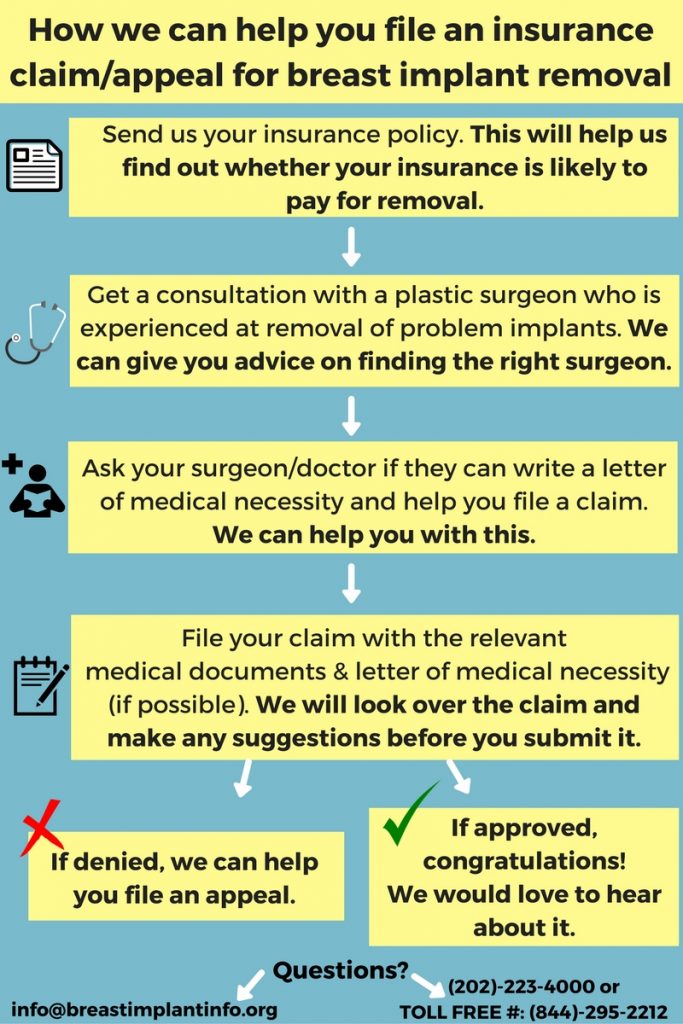
How we can help you file a claim-appeal for breast implant removal -final

Psst! Industry has taken over FDA

By Jim Dickinson, Medical Device and Diagnostic Industry
September 17, 2015

Just six years ago, the industry-at-arm’s-length tradition held sway—as it had throughout FDA’s history—when Califf was passed over in Obama’s hunt for a commissioner.

The reason? The Duke University researcher of numerous drug industry clinical trials was then viewed as being too close to the pharmaceutical industry—the same reason that had for decades kept other similarly situated candidates from being chosen to lead the world’s premier health regulatory agency. New York health commissioner Margaret Hamburg was chosen instead.

[…]

No matter how sincere a commissioner might be—and Hamburg was—in divesting him or herself from all potential appearances of possible conflicts of interest before taking on the job, suspicions will linger in the minds of people and groups ready to provoke investigations that cost taxpayer dollars.

That is exactly what seems to be developing in the case of Califf’s nomination.

In a press release, Public Citizen said the Senate should reject it because of Califf’s close ties with industry over the years. “During his tenure at Duke University, Califf racked up a long history of extensive financial ties to multiple drug and medical device companies, including Amgen, AstraZeneca, Eli Lilly, Johnson & Johnson, Merck Sharp & Dohme and Sanofi-Aventis, to name a few,” the group said. “Strikingly, no FDA commissioner has had such close financial relationships with industries regulated by the agency prior to being appointed.”

Echoing similar concerns, National Center for Health Research president Diana Zuckerman said Califf could have a bias toward industry after working in tandem with companies that funded clinical research at Duke.

When Califf joined the agency last February as deputy commissioner for medical products and tobacco—a step widely seen as grooming him to become commissioner—Zuckerman told Time that his “interdependent relationships” may bring into question his “objectivity and distance.” In the Time article, she pointed out that research has shown that scientists may unknowingly be swayed by their industry relationships.

Read the full article here.