


Category Archives: Problems With Implants
Are your breast implants making you sick?

Research on Silicone Breast Implants and Unexplained Symptoms
by Maura Duffy
Many women with silicone breast implants suffer from symptoms that may seem unrelated to their implants, such as muscle pain, joint pain, chronic fatigue, numbness, memory loss, and dry mouth. Many women never find an answer to these “mystery illnesses” because women and their doctors do not consider a link between the two. A study published in 2013 sheds light on the signs and symptoms that many women with silicone implants experience, and suggests that removing the implants can improve the women’s health dramatically.1
In this study by researchers in the Netherlands, women with silicone gel breast implants who were experiencing unexplained symptoms were invited to participate. Eighty women volunteered and underwent chest x-rays, blood work, and a physical exam to rule out other known causes of their symptoms. The participants filled out a questionnaire about their health and history with breast implants and were followed up with telephone interviews. Most of the women (89%) had breast implants for cosmetic reasons, and had implants for an average of 14 years. Notably, 75% of the women reported that they had allergies before they got their breast implants.
The researchers used the term “ASIA” (autoimmune syndrome induced by adjuvants) to describe the pattern of symptoms that comes on after exposure to an external stimuli such as infection, vaccine, or silicone. All 80 of the women in the study had at least two major symptoms of the following ASIA categories, and 79% fulfilled three or more categories.
- Muscle pain or weakness
- Joint pain or inflammation
- Chronic fatigue
- Neurological symptoms e.g. numbness, impaired coordination, blurry vision
- Memory loss or cognitive impairment
- Fever or dry mouth
Most of the women reported they had not had new health problems for several years after getting implants, and that these symptoms developed gradually. The researchers did not investigate if the women’s implants were ruptured, so it is unknown if the women’s implants were leaking silicone into the body.
Thirty-six out of the 52 women (69%) who had their implants removed experienced reduction in symptoms and 9 out of 52 experienced full recoveries after explantation. Although it is unknown which women will develop ASIA symptoms from silicone, the authors caution that anyone who has allergies may be more likely to have a bad reaction to silicone. The authors conclude that physicians should consider explanting silicone implants and the scar capsules that surrounds them as the treatment for women with silicone breast implants who have these otherwise unexplained symptoms.
A 2016 review also showed that many women who suffer from autoimmune symptoms after getting breast implants improve after removing the implants. In fact, silicone-related complaints (such as autoimmunesymptoms) got better for 3 out of 4 women after they removed their implants. It wasn’t only symptoms that improved, many women diagnosed with autoimmune diseases also improved after they removed their implants, although most of these patients were also taking immunosuppressive therapy before and after removal, and it is not clear if their improved health continued after the immunosuppressive therapy ended.2
To view the original 2013 study, click here: http://www.njmonline.nl/getpdf.php?id=1392
To view the original 2016 study, click here: http://www.breastimplantinfo.org/wp-content/uploads/2016/08/elexplantation-immunol.pdf
What you need to know: Breast cancer, suicide, mastectomy, and breast implants
Diana Zuckerman, PhD
2016
Breast cancer patients often describe having a new appreciation for life, so it is important for women and their friends and family members to know that women who have breast cancer have an increased likelihood of committing suicide for up to 15 years after their cancer diagnosis 3 4.
Even more surprising, the one study of suicide among women who got breast implants after mastectomy found that their suicide rate was 10 times higher compared to other mastectomy patients 5. More research is needed, but for some reason this study has received little attention and no other studies were conducted to learn more. It is important to note that all the women in the study had early-stage breast cancer – which experts agree does not require a mastectomy. In fact, the latest research indicates that women who undergo mastectomy do not live as long as women of the same age and diagnosis who undergo lumpectomy and radiation instead.
The Bottom Line
If mastectomy is not medically necessary it is a bad choice, because cancer patients who undergo mastectomy don’t live as long as lumpectomy patients and they are more likely to commit suicide.
Read more in the article in Women’s Health Issues, and our summary of it here.
Insurance Coverage Information for Breast Implant Removal
Did you know it might be possible to get health insurance coverage for breast implant removal?
I got breast augmentation with implants. Will my insurance cover my breast implant removal?
I got breast implants after a mastectomy. Will my insurance cover my breast implant removal?
Need financial assistance to get your implants removed?
First of all, the original reason for getting your breast implants matters to health insurance companies (as well as Medicare and Medicaid).
If your implants were put in after a mastectomy and your doctor believes that removing your implants is “medically necessary,” then your health insurance is legally obligated to cover your breast implant removal. Click here to learn more about your rights under the Women’s Health and Cancer Rights Act of 1998 (WHCRA).
If the original reason for getting breast implants was for augmentation of healthy breasts, then some health insurance companies will cover your explant surgery if they consider the services to be “medically necessary,” but others will not.
What if my insurance company says that “complications from cosmetic surgery” are not included?
Don’t be discouraged. Almost all health insurance policies will not cover “cosmetic surgery” or “complications from cosmetic surgery” but don’t give up so easily. Many policies have exceptions for complications from breast implants under certain circumstances that they consider “medically necessary” or “reconstructive surgery.”
What are “medically necessary” services?
This is defined differently by different health insurance companies, and sometimes varies in different states as well.
It is important to understand that even if your doctor thinks removing your breast implants is medically necessary, the health insurance policy can refuse to pay if their policy’s definition of medically necessary is different from your doctor’s.
The most generous health insurance policies regarding breast implant removal are usually based on one of the following conditions:
- Silicone gel implants that are proven to be ruptured.
- Silicone or saline implants that are causing Baker III or Baker IV capsular contracture.
- Breast implants that are causing necrosis (death of skin or tissue).
- Breast implants that need to be removed because of infection or ALCL (a rare cancer that can develop around breast implants).
Rupture: If your implants are ruptured, you will need proof. MRIs are the best measurement of implant ruptures, but ultrasounds or mammograms may be accepted too. However, the pressure from mammography can cause old breast implants to break or leak and are not very accurate for detecting rupture, so it is much better to avoid mammography if you can.
Capsular Contracture: Breast implants are a “foreign body” and the natural response for most women is that the body forms scar tissue around the implant, inside your body, to protect your body from this “foreign invader.” This is a natural process. However, it is called capsular contracture when the scar tissue tightens or hardens around the implants. Capsular contracture can happen with either saline or silicone breast implants. It can feel slightly uncomfortable or cause debilitating pain. The mild version of capsular contracture is called “Baker I” or Baker II” (named after a Dr. Baker who devised the categories) and the most severe is called “Baker III or Baker IV.” Baker III or Baker IV breasts are hard and/or painful. Insurance companies usually only consider Baker III and/or Baker IV level capsular contracture to be a medically necessary reason for removal.
Pain: Pain caused by capsular contracture is often considered justification for insurance coverage of removal. In addition, if your implants are causing extensive pain because of nerve damage or the weight of the implants, it is sometimes possible to get your insurance company to pay for removal.
Improved health after removal: If you can prove that your symptoms have drastically improved after your breast implants were removed, you may be able to make a case that it was medically necessary to remove them in the first place. If you are no longer in pain, or are now able to return to work after being unable to work as a result of complications from your breast implants, you could make a strong case for why the implant removal was needed. However, it is always riskier to pay for implant removal and then hope the surgery will be reimbursed.
What is generally NOT considered “medically necessary”?
Unfortunately, most insurance companies do not consider any autoimmune diseases/symptoms or anxiety related to your implants to be proof that it is medically necessary to remove your breast implants. However, many women who have those symptoms also have other problems, such as leaking silicone implants or capsular contracture. So, focus on the symptoms that the insurance company cares about, not the ones that they don’t cover.
What does “reconstructive surgery” mean?
Some insurance companies will consider your breast implant removal “reconstructive surgery” as opposed to “cosmetic surgery” and therefore medically necessary when the purpose of your surgery is to treat a medical condition. This usually means that you have Baker grade III or IV capsular contracture, and/or limited movement affecting your ability to do simple tasks such as reaching above your head or combing your hair. Your breast implant removal may also be considered reconstructive if you have lumps of silicone in the breast area that interfere with the diagnosis of breast cancer.
How do I know when/if my insurance plan considers breast implant removal “medically necessary”?
To find out what your insurance plan covers, you can read through a copy of your actual policy. There are often 3 versions of your health insurance policy:
- A short summary, also called a Summary of Benefits and Coverage. This will not have the information you need.
- A description of the plan. This will have more information than the summary, will probably specify that cosmetic surgery is not covered, and may even mention breast implants specifically. However, it usually will not have the specific information you need to know if your policy will cover implant removal.
- The specific policies regarding breast implants or cosmetic surgery complications are in the “contract” that you sign when you buy health insurance coverage. This contract has all the very specific policies that you need to know about. As a customer who bought that policy, you are entitled to receive a copy online or in the mail, so you can call to ask for it. If your current insurance policy does not cover implant removal, you should shop around to look for one that does. However, that can be difficult to find out.
Persistence can make a difference! For example, Medicare denied Karen’s initial claim for breast implant removal because they concluded that explanting her ruptured silicone gel implants was not medically necessary. In her appeal, she sent copies of several insurance policies from other companies, stating that they cover surgical removal of silicone gel breast implants when they are ruptured. Medicare finally granted her coverage for her explant surgery. Karen is already feeling better than she had in months/years.
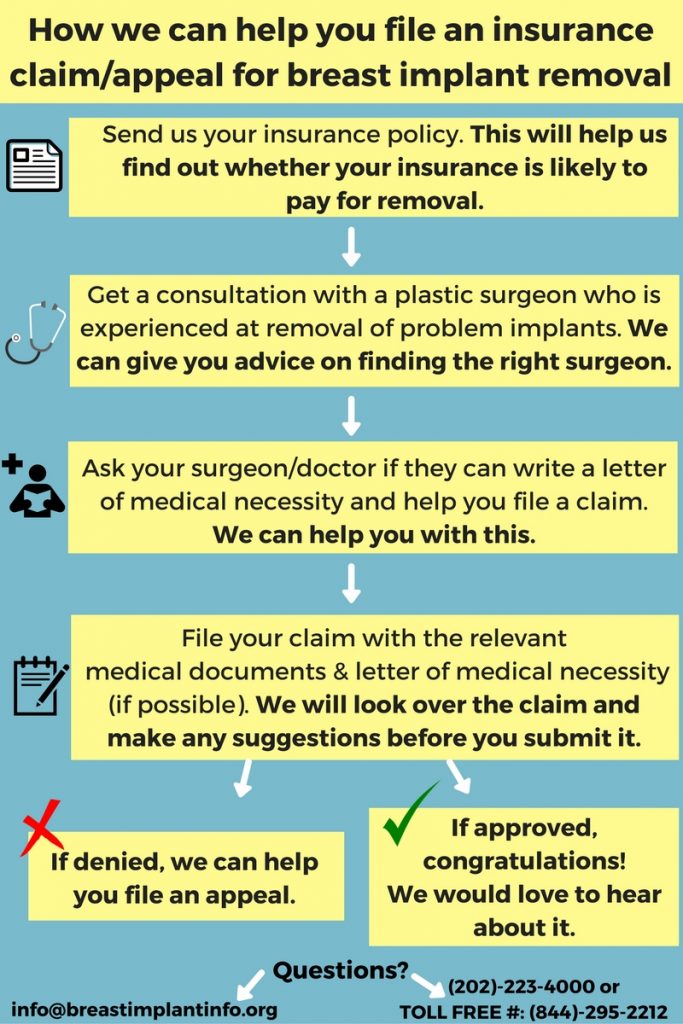
We would be happy to help you with this. To start that process, you can fill out our very short survey here: https://www.surveymonkey.com/s/KHCWGM8
What do I need from my doctor?
When the time comes to ask the insurance company for coverage, it helps if your doctor sends a letter to your insurance company detailing why removal of your breast implants is medically necessary. He/she should focus on the complications that you have that are more likely to be covered by your insurance (such as implant rupture or Baker III or IV capsular contracture). It is usually better to not talk about your other symptoms (such as autoimmune symptoms), because it will detract from what the insurance company needs to hear.
What if I have Medicare?
Your doctor should be able to call Medicare’s provider line to check if your breast implant removal surgery will be covered.
Q: My implants are silicone, they were implanted before 2007, and my insurance has denied coverage to remove my implants (or I have no insurance or Medicaid). I do not have Medicare. Can you help me?
If this is the case, you may be eligible for a financial assistance program to help you afford your breast implant removal. Please visit www.explantassistance.com and download the Notice of Interest form. If you have any questions, you can contact the Program Administrator, Jeff Condra, at jcondra@oplc.org or 205-252-6784.
What do I need to know about breast implant removal surgery?
See our article here.
Not Receiving Coverage for Breast Implant Problems?
We want to make sure that health insurance policies cover treatment and implant removal when it is medically necessary.
Under “Obamacare” health insurance companies can’t deny coverage for pre-existing conditions and can’t discriminate against women. But some insurance companies are planning to deny coverage for any complications related to breast augmentation, even if treatment is medically necessary (such as removal of leaking breast implants, painful capsular contracture, or ALCL, a rare type of lymphoma that can be caused by breast implants). We believe that this would be illegal.
We have spoken to several state officials who agree with us, but they tell us they have not had any complaints about lack of coverage in recent years and don’t think it is a problem.
If you or anyone you know had a health insurance policy that refused to pay for medically necessary treatment related to breast implant problems, please fill out our survey here immediately! Have additional questions? Email us at info@breastimplantinfo.org OR call us TOLL FREE at (844) 295-2212.
We know that many women have had this experience, but we need to hear from the women themselves (or their family members). Any experiences like this within the last 3 years are especially welcome.
If you can help spread the word through friends or social media, we’d be grateful!
Less Radical Surgery is a Healthier Choice for Women with Breast Cancer
Brandel France de Bravo, MPH and Diana Zuckerman, PhD
Updated 2017
Experts have long advised that lumpectomy patients live as long as mastectomy patients. But the latest research, based on hundreds of thousands of women, indicates that women with DCIS or early-stage breast cancer are more likely to live longer, healthier lives if they choose less radical surgery.
Four studies indicate that lumpectomy patients live longer.
In a study of almost half a million women with breast cancer in one breast, Harvard cancer surgeon Dr Mehra Golshan reported in 2016 that those undergoing double mastectomies did not live longer than women undergoing a mastectomy in only one breast.[1] On average, women who underwent a lumpectomy instead of mastectomy lived longer than women undergoing either a single or double mastectomy for cancer in only one breast.
Similarly, a study of more than 37,000 women, also published in 2016, women with early-stage breast cancer who underwent lumpectomy with radiation were more likely to be alive 10 years later, compared to women who underwent mastectomies.[2] They were also less likely to have died of breast cancer or of other causes. This was true even when age and factors that could influence survival were taken into account.
Dr. Shelly Hwang and her colleagues found similar results in a 2013 study of more than 112,000 California women who had lumpectomies to remove their early-stage breast cancer were more likely to be alive and free of breast cancer 5 years after surgery than women who had mastectomies.[3] The women had been diagnosed between 1990 and 2004 with either Stage 1 or 2 breast cancer. All of them had either a lumpectomy with radiation or a mastectomy. After surgery, their health was monitored for an average of 9 years (the women were all studied for 5-14 years). The women who had a lumpectomy and radiation tended to live longer than the women who had mastectomies, when controlling for age at diagnosis, race, income, education levels, tumor grade or the number of lymph nodes with cancer. Lumpectomy with radiation was especially effective for women who were 50 years and older with hormone-receptor positive tumors: they were 19% less likely to die of any cause during the study than women just like them who had mastectomies. Perhaps more surprising, they were 13% less likely to die of breast cancer than women just like them who had mastectomies.
In a study published in 2014, Dr Allison Kurian and her colleagues at Stanford studied 189,734 California patients diagnosed from 1998 to 2011 with early-stage breast cancer in one breast, ranging from Stage 0 (DCIS) to Stage 3.[4] The study showed that the percentage of women having both breasts when only one breast had cancer (called bilateral mastectomies) increased dramatically, but there was no advantage to that more radical approach. Instead, the women who underwent lumpectomies (removing only the cancer, not the entire breast) lived longer and were more likely to be alive 10 years after diagnosis compared to women undergoing a mastectomy. Women who had both breasts surgically removed did not live longer than those undergoing a mastectomy on one breast.
Compared to women in other countries, women in the U.S. who are diagnosed with early-stage breast cancer are more likely to remove both breasts even if only one has cancer. It is not known why bilateral mastectomy provides no medical advantage, but a study of more than 4,000 cancer patients by Dr. Fahima Osman at the University of Toronto indicates that having a healthy breast removed in addition to the breast with cancer increases the chances of medical complications.[5] Removing the healthy breast (“contralateral breast”) doubled the chances of having wound complications in the first month after surgery: from about 3% for women who had only the breast with cancer removed to about 6% for women who also had the healthy breast removed. About 4% of women who had a single mastectomy experienced some kind of complication (not necessarily wound-related) in the 30 days after surgery, compared to 8% of women who had both breasts removed. The risk of cancer in that healthy breast was already less than 1% per year unless the woman has a BRCA gene or some other very high risk factor.[6] Hormone pills such as tamoxifen or aromatase inhibitors can further reduce that already low risk.
The Bottom Line: these enormous studies of women in the U.S. and other countries make it clear that women with DCIS or early-stage breast cancer should undergo surgery to remove only the DCIS lesion or cancer, not the entire breast. The women who undergo lumpectomy with radiation usually live longer than those who undergo mastectomy or bilateral mastectomy. In addition, mastectomy patients who have breast implants are more likely to kill themselves compared to mastectomy patients without implants. Unfortunately, the fear of breast cancer and desire to “get rid of the problem” has resulted in too many women undergoing mastectomies or bilateral mastectomies that threaten their lives. Physicians and breast cancer advocacy groups need to make sure that patients understand why lumpectomy with radiation is a better idea.
For a free booklet on treatment options for DCIS, click here. For a free booklet on treatment options for early-stage breast cancer, click here.
References
- Wong, S., Freedman, R., Sagara, Y., Aydogan, F., Barry, W., & Golshan, M. Growing Use of Contralateral Prophylactic Mastectomy Despite no Improvement in Long-term Survival for Invasive Breast Cancer. Annals of Surgery. 2016 March; doi:10.1097/SLA.0000000000001698
-
Marissa C. van Maaren, et al, “10 year survival after breast-conserving surgery plus radiotherapy compared with mastectomy in early breast cancer in the Netherlands: a population-based study”. Lancet Oncol. 2016 Aug; 17(8): 1158–1170. Published online 2016 Jun 22. doi: 10.1016/S1470-2045(16)30067-5
- Hwang ES, et al “Survival after lumpectomy and mastectomy for early stage invasive breast cancer: The effect of age and hormone receptor status” Cancer 2013 April 1; 119(7); DOI: 10.1002/cncr.27795.
- Kurian, Allison W., Daphne Y. Lichtensztajn, Theresa H. M. Keegan, David O. Nelson, Christina A. Clarke, and Scarlett L. Gomez. “Use of and Mortality After Bilateral Mastectomy Compared With Other Surgical Treatments for Breast Cancer in California, 1998-2011.” The Journal of the American Medical Association 2014; 312(9): 902-914. DOI:10.1001/jama.2014.10707
-
Osman, Fahima, et al “Increased postoperative complications in bilateral mastectomy patients compared to unilateral mastectomy: an analysis of the NSQIP database.” 2013 Oct; 20(10): 3212–3217. Published online 2013 Jul 12. doi: 10.1245/s10434-013-3116-1
- National Cancer Institute. Breast Cancer Treatment (PDQ®). http://www.cancer.gov/cancertopics/pdq/treatment/breast/healthprofessional/page1
Already Have Implants and Have Problems?
Don’t panic! If you are having any kind of problems, contact your plastic surgeon, unless you are really concerned about the quality of his or her care. If you feel like your doctor or plastic surgeon is not taking you seriously, contact us. Also, make sure you report any problems you are having to the FDA.
What do I do if my implant breaks?
Most experts agree that it is important to remove a ruptured implant as soon as possible, especially if it contains silicone gel. Removal of implants is called explantation.
Usually a ruptured saline implant is harmless, unless the saline contains bacteria, mold, or fungus, which can happen inside a woman’s body. If your implant has broken, and you feel sick, have a temperature, and/or a rash, you should see a doctor immediately. You could have an infection from contaminated saline.
It is important to have ruptured silicone gel implants removed as soon as possible. The longer the silicone is allowed to remain in the body, the more time it has to migrate to other parts of your body, like lungs or lymph nodes, where it can’t be removed. Unfortunately, nobody knows for sure what will happen as a result of silicone in the body because no one has conducted any research on the subject.
Everybody is different. Some women do not respond strongly, if at all, to breast implants. Others become very, very ill.
Remember: If you choose to get your implant removed because you don’t like the way they look or because of health reasons, your breasts will not look the same as they did before surgery.
Also, if you get silicone gel implants removed because of silicone leakage, your surgeon may have to remove part of your own breast as well, leaving your chest smaller than what you started out with.
What if something else is going wrong?
If you want to find out about common implant problems, in addition to problems when implants break, click here.
If You’re Having Problems
Are you having problems that might be related to your breast implants? Sometimes it’s hard to know. Here are some common complications.
Capsular Contracture:
Almost every woman with breast implants has scar tissue surrounding her implants. This scar capsule doesn’t show — it’s inside her breast, and is her body’s natural way of protecting her from a foreign object. Sometimes, however, that capsule is too tight for the implant. Capsular contracture is when the capsule is too tight and feels like it is squeezing the implant.
• It can happen with either saline or silicone gel breast implants
• It can be slightly uncomfortable or very painful
• It can change the shape of your breast, or make it look round and unnatural
• You may need surgery to fix it
• Once it is surgically fixed, it is likely to happen again
| Symptoms such as: | Could mean: |
|
pain in the breast, breasts look different from each other, breast feels firm or very hard, breasts look like round balls |
capsular contracture
|
This condition will not usually get better by itself. If it is very painful or hard, it will require surgery to remove the scar tissue capsule and perhaps the implant. Some of your own breast tissue might get mixed in with the capsule, and you might lose some of your natural breast. Many insurance companies will pay to have your implant removed if a woman has Baker Grade III or IV contracture, which are the most severe types, because when implants are that hard they are especially likely to interfere with mammography and the detection of breast cancer.
Rupture:
The implant is covered with a silicone envelope, which can tear or break. A rupture can be caused by a defect in the implant, daily stresses on the implant, an accident or other trauma, an accidental cut during implant surgery or biopsy, or the aging of the implant.
• Ruptured saline implants usually deflate quickly.
• A silicone gel leak or rupture can go unnoticed, even for a period of years.
| Symptoms may include: | Could mean: |
|
decreased breast size, uneven size of breasts, pain or tenderness, tingling, swelling, numbness, burning, changes in sensation, lumps |
silicone gel-filled implant rupture |
|
chest pain, breast rash, change in size of breast |
saline implant rupture
|
The older implants are, the more likely they are to break or leak. Although implants can rupture at any time, the FDA found that most rupture by the time they are 10 years old.
Aside from surgery, the best way to confirm a rupture is with an MRI, or perhaps an ultrasound. These methods require a trained eye to see a leak or rupture. A mammogram is not accurate enough to find a rupture or leak.
Most insurance companies will not pay to have a ruptured implant removed, especially if the implants were for augmentation. Reconstruction patients have an easier time obtaining insurance coverage for removal of implants, but will need to prove the implant is ruptured, with an MRI or other test.
Most experts agree that ruptured implants should be removed as soon as possible, especially if it is a silicone gel implant. Silicone gel can leak from the implant into healthy breast tissue and go other parts of your body, such as the lungs and lymph nodes, where it could be impossible to remove.
Some women with leaking silicone breast implants have had to have all their own breast tissue removed because the silicone moved throughout their breast. The result is a mastectomy, not because of cancer but because of silicone.
Many doctors believe that silicone is harmless, and may tell women with ruptured implants that they do not need to have them removed. However, it has been conclusively proven that silicone gel from a broken implant can leak out and cause permanent damage to healthy breast tissue or skin. In addition, the FDA found that women with leaking silicone implants are more likely to report several serious, debilitating illnesses, compared to women whose implants have not broken.
For more information or personal stories, click here.
Infection:
As with any surgery, infections can happen. Most infections appear shortly after surgery, within a few days or weeks. The most serious infections can cause toxic shock syndrome and can be fatal or result in gangrene. If the infection is very serious, the implant will need to be removed to treat it, and can be replaced after the infection has cleared up.
All implants, including breast implants, attract bacteria.
If a saline implant is no longer sterile, it might cause an infection when it breaks. Bacteria, mold, and fungus can grow inside saline implants.
| Symptoms may include: | Could mean: |
| Infection |
Disease and Serious illness:
Everyone agrees that implants can cause local complications, such as those listed above. There is much more controversy about whether it can cause diseases or disorders. Some women can have implants for many years and never have any problems, but as the years go by, many women with implants become seriously ill. Common symptoms include joint pain or stiffness, memory problems, trouble concentrating, fatigue, flu-like symptoms that don’t go away, or pain throughout the body (fibromyalgia). Auto-immune diseases such as rheumatoid arthritis, lupus, and scleroderma are also problems among women with implants. Are these symptoms caused by implants, are women who are susceptible to these illnesses more likely to get them if they have breast implants, or would these women have become ill even if they didn’t have implants?
Research has not yet answered those questions. Women with implants are more likely to have these diseases and symptoms in some studies, but not others. The Institute of Medicine (IOM) summarized 17 epidemiological studies that attempted to answer this question, but unfortunately, most of the studies included relatively small numbers of women who had implants for very short periods of time. Longer-term studies conducted after the IOM report have found some risk of diseases among women with implants. That is why the IOM study is not proof of implant safety. For more information on the IOM study, please click here >
What studies suggest that implants cause diseases? A study by FDA scientists found that women with leaking silicone gel implants were more likely to develop fibromyalgia and several other painful diseases than women with implants that were not leaking. This study is described in more detail, click here >
In the only study of women with rheumatology symptoms who had their implants removed, doctors found that 97% of women with pain and other rheumatology symptoms felt better after their breast implants were removed and not replaced. Many symptoms lessened or disappeared over the next few months. In contrast, 96% of the women who did not have their implants removed became even more ill. This study was conducted by a physician (Dr. Noreen Aziz) at the University of South Florida Colleges of Medicine and Public Health, who now works for the National Cancer Institute.
Studies published in 2001 by other scientists at the National Cancer Institute raised questions about the long-term safety of breast implants. Unfortunately, many doctors are not aware of these recent studies. One study found that women who had breast implants for at least eight years were twice as likely to die from brain cancer, three times as likely to die from lung cancer or other respiratory diseases, and four times as likely to commit suicide, compared to other plastic surgery patients. A second study found that women with breast implants for at least eight years were 21% more likely to be diagnosed with cancer compared to other women their age.
More large, long-term, studies of women who have had implants for 10 years or more need to be conducted in order to find out if these risks of cancer or death increase or decrease when women are studied for longer periods of time.
These are some of the diseases that need to be carefully studied among women with implants, to see if women with implants are at greater risk:
| Symptoms may include: | Could mean: |
|
dry mouth, dry eyes, persistent cough
|
Sjogren’s syndrome
|
|
joint discomfort, pain, stiffness, swelling
|
Rheumatoid arthritis
|
|
chronic fatigue
|
Chronic fatigue syndrome
|
|
difficulty swallowing or breathing
|
esophogeal immotility
|
|
memory impairment
|
neurological impairment
|
|
muscle weakness, walking problems, tremor, muscle spasm, slowed ability to think, poor memory
|
MS – Multiple Sclerosis*
|
|
muscle pain, stiffness, unusual fatigue
|
fibromyalgia
|
|
strong allergic reactions
|
chemical sensitivity
|
|
white or blue fingers and/or toes in the cold
|
Raynaud’s syndrome
|
|
excessive hair loss
|
an autoimmune response
|
|
hardening of skin
|
Scleroderma
|
|
achy or swollen joints, extreme fatigue, skin rashes, anemia, sensitivity to sunlight, kidney involvement, fever
|
Lupus
|
* Women with implants have been known to experience MS-like symptoms and have been misdiagnosed as having the disease when they do not.
If Your Implant Breaks
All breast implants will break. Some even break during the first few months, but the older your implant is, the more likely it is to break. However, it is not always obvious when an implant is broken. Here is some useful information.
When a saline breast implant breaks
When saline (salt water) breast implants break, it will probably leak very quickly. When this happens, the implant ‘deflates,’ much like a balloon that has lost the air inside. Your breast will change in size or shape. It’s less common for saline to leak slowly, although it can happen. When the saline leaks, the body absorbs it. It’s usually harmless, unless there is fungus or bacteria inside the implant, which can cause a serious infection. You should go to a doctor right away to see if you need antibiotics.
How do I know if my saline breast implant has broken?
Saline implant ruptures are usually obvious. You should be able to see the difference in the size or shape of your breast. You won’t need an MRI or sonogram, and be sure not to get a mammography because the pressure can cause the implant to break.
When a silicone breast implant breaks
When a silicone gel breast implant breaks, the contents usually leak very slowly. A ruptured silicone gel implant may not be obvious for many years. Sometimes the rupture is discovered only when the implant is removed.
When a silicone implant breaks, one of two things can happen. If you are lucky, the leaking silicone will stay inside the capsule, which is the thick layer of scar tissue that naturally grows around the implant. When this happens, the silicone stays where it is.
However, the silicone can leak outside of the scar tissue capsule. When this happens, silicone can migrate to other parts of the body, including the lymph nodes under the arm and major organs such as the lungs where, it is impossible to remove. The longer a woman waits to have a ruptured silicone gel implant removed, the more time the silicone has to leak inside her body.
How do I find out if my silicone implant has ruptured?
If your silicone gel implant ruptures, you might notice a change in the size or shape of your breast. Or you might feel pain or tenderness, swelling, numbness, burning or tingling. It is also possible to have a ‘silent rupture,’ where you don’t have any symptoms at all and you don’t realize that your implant has broken.
Since most women don’t notice when a silicone gel implant breaks, it is important to have an MRI to check for leakage. A mammogram is not accurate and the squeezing could make the contents of the implant leak outside the scar capsule.
Can broken implants make me sick?
According to the FDA’s research, women with leaking silicone implants are more likely to report fibromyalgia (which causes body pain) or several other diseases. There is no research on the health risks of broken saline implants.
What do I do if my implant breaks?
Most experts agree that it is important to remove a ruptured implant as soon as possible, especially if it contains silicone gel. Removal of implants is called explantation.
Usually a ruptured saline implant is harmless, unless the saline contains bacteria, mold, or fungus, which can happen inside a woman’s body. If your implant has broken, and you feel sick, have a temperature, and/or a rash, you should see a doctor immediately. You could have an infection and antibiotics might be all you need to get well.
However, if you have ruptured silicone gel implants, they should be removed as soon as possible. The longer the silicone is allowed to remain in the body, the more time it has to migrate to other parts of your body, like lungs or lymph nodes, where it can’t be removed. Unfortunately, nobody knows for sure what will happen as a result of a lot of leaking silicone in the body.
Everybody is different. Some women do not respond strongly to silicone. Others become very, very ill.
Explantation surgery
If your implant is not broken, most doctors will not want to remove them. However, women who get very ill as a result of breast implants often fnd that their health improves after removal. A study of removed implants that were not replaced by Noreen Aziz and her colleagues found that 97% of women with pain and other rheumatology symptoms felt better after their implants were removed and not replaced. Many symptoms lessened or disappeared over the next few months. In contrast, 96% of the women who did not have their implants removed became even more ill.
It can be easy or difficult to remove breast implants, but it is almost always more complicated to remove a silicone gel implant than it was to put it in. This is especially likely if the implant has ruptured, because it’s important that silicone gel from a broken implant does not spill or remain in the body.
The surgeon who performed your original surgery is not always the best choice for removing the implants. Explantation results can be excellent or disastrous. Some cosmetic surgeons are very experienced at putting implants in, but not at taking them out.
However, there are some plastic surgeons who are very experienced at removal and are skilled at getting the best possible cosmetic result. The surgeon you choose should be experienced with explantation, board certified, and should be willing to show you pictures of what the patients looked like after their implants were removed, or better still, offer to have former patients talk to you. Find out if they were happy with their doctor and with their results.
Make sure that when your implants are removed, the scar tissue capsule is also removed, because it might contain bacteria or chemicals from the implants.
Most experts believe that removing the implants ‘en bloc’ is very important. This means that the entire implant and the entire scar tissue capsule surrounding it are all removed together. Removing implants en bloc makes it easier to remove any silicone that leaked from a broken gel implant, and also helps remove silicone or other chemicals that may have bled from the silicone outer envelope. You should ask your doctor if he or she has experience doing an en bloc removal.
Removing implants en bloc is especially important if you have been sick since receiving your implants. Some experts believe that symptoms such as joint pains, chronic flu-like symptoms, memory loss, confusion, or a burning sensation could be a result of silicone that has leaked from your implant, and perhaps outside the scar tissue capsule. If this is the case, leaving the scar tissue capsules, or part of them, and/or silicone in your body probably isn’t going to let you recover as well as you might. It is also possible that while the silicone did not make you sick before, silicone that is left behind in your body could make you sick later, because your body will react this foreign material.
What happens if I remove my implants and don’t replace them?
Some surgeons discourage patients from removing their implants without replacing them, because they believe implants are safe and because they’re concerned that the patient will be very unhappy with her appearance after the implant is removed. The breast tissue stretches from the implant, and if the surgeon isn’t skilled in explantation without replacement, the breast is unlikely to be as attractive as it was before the implant surgery.
If the surgeon is not skilled at removing ruptured implants, the silicone can spill into healthy breast tissue, which then may need to be removed as part of the surgery. However, after an experienced explant surgeon removes implants, many women are very pleased with the way their breasts look and feel.