
Surgery has Risks
Like with all surgeries, you always go in knowing that something potentially could go wrong. Usually it won’t but sometimes it will, and some people have died from breast implant surgery. Risks from surgery include infection, hematoma (blood or tissue collecting around an implant), and serious complications that can happen with anesthesia. Infections are usually easy to treat, but doctors have reported that some women have gotten toxic shock syndrome from infections, and others have gotten gangrene.
The main risks from breast implants are not from the surgery itself. The main risks are what happens in the months and years after the surgery. You should keep those risks in mind while making your decision.
A few side effects…so you know how the result may turn out
• Implant surgery can cause you to lose sensitivity in your breasts, especially in your nipples. Or your breasts can become so sensitive that it is painful to be touched. Either problem may dampen sexual intimacy.
• You may suffer from capsular contracture: 
This is when scar tissue forms around the implant (because it is a foreign body), and causes your breasts to become unnaturally hard, painful, have an unnatural shape, or become lopsided.
This young woman’s breasts look unnatural and the left one is a different shape than the right because of capsular contracture.
• If you get saline implants, they could make a swishing sound that you or others near you can hear.
• Breasts with saline implants tend to feel unnaturally cool compared to real, warmer breasts.
• If you snowboard, ice skate, or play in the snow, your saline implants may feel very uncomfortably cold.
And when you’re older…
Even if you’re not concerned with the future right now, the truth is that getting older is inevitable. So, it is very important to think about any risks breast implants could give you that would affect your life in the years to come.
• Do you ever want to have kids? Breast feeding your children is extremely important to their health. Research shows that women with implants are more likely to have an inadequate supply of milk for their babies, or nursing could be painful. So if having healthy babies is important to you, you may want to delay breast implants until afterwards.
• Breast Cancer: The idea of breast cancer may not have even crossed your mind yet, but when you get older and need mammograms, implants interfere with being able to detect cancer early. Even the best mammograms will miss up to half of the breast area where cancer can grow, because it will be hidden by the implants.
Life-threatening Risks
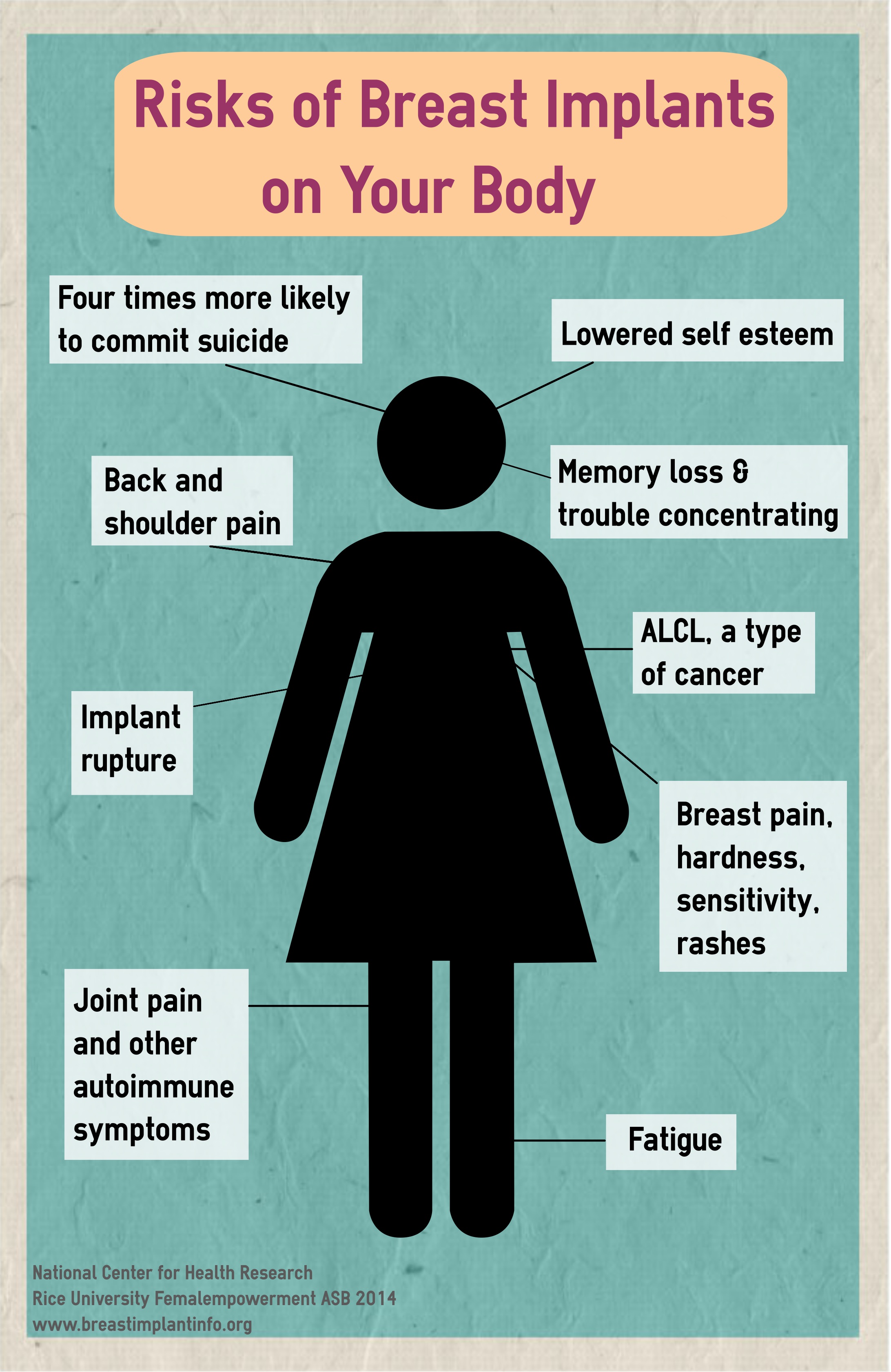
Below is a list of what research shows about the risks of getting breast implants. Keep these dangers in mind before making your decision.
According to the National Cancer Institute, compared to other plastic surgery patients, women with breast implants are:
• Twice as likely to die from brain cancer
• Three times as likely to die from lung cancer
• Four times as likely to kill themselves
According to an FDA study there may be a link between implants and some auto-immune and connective tissue diseases. A link to fibromyalgia (which causes chronic muscle pain and severe fatigue) has also been found.
Who Should Avoid Breast Implants?
Implants are riskier for some girls and women than others. If you have had an autoimmune disease or if family members do (such as rheumatoid arthritis, lupus, or chronic fatigue syndrome), you should not take the chance of a foreign body like breast implants. If you are concerned about breast cancer, you should not get implants since they interfere with detecting breast cancer early by interfering with mammograms.
Need more facts?
The two implant companies that can legally sell saline breast implants in the U.S., Mentor and Inamed, conducted their own studies about the risks of saline implants.
If you’re considering silicone gel breast implants, read about an implant makers’ own studies of silicone gel implants here.
Some other risks to consider…
Money
Breast augmentation surgery usually costs about $4,000 to $6,000). If a doctor is charging less than that, be very cautious. Make sure he or she is a board-certified plastic surgeon and is very experienced with implants.
Paying this kind of money is not a one-time deal. You will need to spend more money to replace your implants when they break or wear out, or pay to have them removed even if you don’t want them replaced. Even if the implant is under warrantee, or if your doctor offers his services for free if problems arise, the anesthesia and other fees will still total thousands of dollars.
Health insurance will not cover breast augmentation, and usually will not pay the cost of medical care if you have problems that need to be fixed. Even if your implant breaks or is causing an allergic reaction, health insurance probably will not pay the cost of medical care. You will either have to ask your parents to pay to fix or replace the implants, or take out a loan yourself to cover the costs.
We have heard from teens and young women who arranged to pay off their augmentation on a monthly basis, but then needed to have them removed before they had finished paying for the implants themselves. Going into debt to get implants is risky. Our advice: only get implants if you can afford to have them removed if something goes wrong.
Your Looks
Almost every teenage girl is concerned with her looks, and that is obviously the reason some get implants. If breast implants gave every girl beautiful breasts for the rest of her life, that might seem like a good idea. However, augmented breasts that look natural at first, can change and look and feel much less natural and less attractive in just a few months or years. We’ve heard from celebrities who were embarrassed to be hugged because their breasts were so hard.
If you need to have your implants removed, they may look very saggy and stretched out – not nearly as good as they looked before you got implants.
 That is definitely not what you want to accomplish.
What do we mean by looking unnatural? Some girls describe their “new” breasts as looking like two balls attached to their chest. Others find that one breast is much higher than it should be, or you can see or feel the implant. If the breasts look round and if there is space between the breasts instead of cleavage, those are two common signs of breast implants.
Keep in mind…
You’re still growing! Even if you’ve heard this before, it’s still true. Not only may your breasts still be growing, but the rest of your body could be too. Most teens find their breasts look more voluptuous in their early 20’s than they did in their teens, without augmentation.
Also, you may want to wait a little longer to see if you really want implants, or if you are still experiencing normal teenage self-consciousness. The truth is, the older you get, the more accepting you become of your body and the better you feel about yourself. Research on girls ages 11-18 found that girls liked their body more every year. In other words, older teens feel better about their bodies than younger teens. The study also found that the features that girls were most dissatisfied with reflected the ideal looks emphasized in books, mass media and advertisements.