

Category Archives: What You Need To Know

Breast Implant Associated-Anaplastic Large Cell Lymphoma (BIA-ALCL)

What is BIA-ALCL?

Anaplastic Large Cell Lymphoma (ALCL) is a rare form of cancer of the immune system. Experts now agree that women with breast implants are more likely to develop ALCL1. Since it will develop in the breast area, it is called Breast Implant Associated-ALCL (BIA-ALCL). Usually, this cancer develops in the scar tissue (capsule) that forms around a breast implant2. Sometimes this cancer can be found in the lymph nodes. If it’s not treated quickly, it can be fatal.

How can breast implants cause cancer?

Scientists are trying to figure out why ALCL forms near breast implants. Many experts believe that cancer may develop in response to chronic inflammation caused by bacteria3. Most cases of BIA-ALCL have been reported in women with textured implants, which provide a better surface for bacteria to grow.

Is BIA-ALCL really rare?

The U.S. Food and Drug Administration (FDA) says that it has received 359 reports of ALCL, including 9 deaths, in women with breast implants. They say that since millions of women have breast implants, BIA-ALCL must be very rare. However, the Australian version of the FDA (called the Therapeutic Goods Administration) estimates that between 1 in 1,000 and 1 in 10,000 women with breast implants will develop ALCL4.

More than 300,000 women get breast implant surgery every year. If the Australian estimates are correct, about 30-300 of those women will develop ALCL every year. However, many experts believe that ALCL is underreported and therefore the chance of developing ALCL from breast implants is likely higher than the current estimates. Although awareness of BIA-ALCL is increasing, many doctors are still unaware of the risks and symptoms.

How will I know if I have BIA-ALCL?

All women with breast implants should be seeing a doctor regularly to check for any problems. If you experience redness or swelling near your implants you should see a doctor immediately. A swollen breast is usually an infection, but the fluid around your implants should be tested for ALCL as well.

Although a swollen breast is the most common symptom of BIA-ALCL, not all women with BIA-ALCL have noticeable swelling. Some women with BIA-ALCL reported feeling a lump near their implant or capsular contracture. If you find a lump, see your doctor immediately to check for breast cancer or ALCL. If you have capsular contracture, keep in mind that it could be a sign of BIA-ALCL, even though it probably isn’t.

How can I prevent BIA-ALCL?

You can’t prevent ALCL if you have breast implants. However, you can watch out for warning signs mentioned and have regular checkups with a doctor who knows about BIA-ALCL and other risks associated with breast implants.

What is the treatment for BIA-ALCL?

ALCL is treated by removing the implant and all of the surrounding scar tissue. This procedure is called a total capsulectomy, or an “en bloc” removal. This is done to make sure any cancer cells in the tissue are removed.

If any of your lymph nodes are found to have ALCL, they will also be removed.

If the cancer is found later and has spread, you may need to be treated with chemotherapy or radiation therapy.

All articles are reviewed and approved by Dr. Diana Zuckerman and other senior staff.

References

  1. FDA, Center for Devices and Radiological Health. (2017). Breast Implants – Breast Implant-Associated Anaplastic Large Cell Lymphoma (BIA-ALCL). Retrieved from https://www.fda.gov/MedicalDevices/ProductsandMedicalProcedures/ImplantsandProsthetics/BreastImplants/ucm239995.htm
  2.  Swerdlow, S. H., Campo, E., Pileri, S. A., Harris, N. L., Stein, H., Siebert, R., et al. (2016). The 2016 revision of the World Health Organization classification of lymphoid neoplasms. Blood, 127, 2375-2390. doi:10.1182/blood-2016-01-643569
  3.  Kadin, M. E., Deva, A., Xu, H., Morgan, J., Khare, P., Macleod, R. A., Epstein, A. L., et al. (2016). Biomarkers Provide Clues to Early Events in the Pathogenesis of Breast Implant-Associated Anaplastic Large Cell Lymphoma. Aesthetic Surgery Journal, 36(7), 773-781. doi:10.1093/asj/sjw023
  4. Therapeutic Goods Administration. (2017). Breast implants and anaplastic large cell lymphoma. Retrieved from https://www.tga.gov.au/alert/breast-implants-and-anaplastic-large-cell-lymphoma
What to Ask Your Plastic Surgeon

Sometimes it’s hard to know what questions to ask and who to ask. Here are some important questions to ask a board-certified plastic surgeon if you’re seriously considering breast implants:

  • If your doctor shows before and after photographs of patients, ask if these were their own patients.
  • Ask to see photographs of his or her patients, and including how they looked a few years later.
  • Ask your doctor for written information about the risks of breast implants and read that information at least one week before surgery so you have time to ask questions and gather more information.
  • Ask for the informed consent form at least one week before surgery.
  • If there is a warranty on the implants, what is included? What isn’t included?
  • Ask whether the doctor will remove your implants for free if you have serious problems. If so, will the surgical center services also be free? What if you want them removed, but the doctor doesn’t think it is necessary?

If you are still unsure about getting breast implants, seek advice from someone that has gone through breast implant surgery at least 5 -10 years ago. They may be able to help you make the decision that is best for you. Click here to read some personal stories from women who had breast implants.

All articles are reviewed and approved by Dr. Diana Zuckerman and other senior staff.

Breast Implant Problems? Obamacare Can Help!

Farzana Akkas, National Center for Health Research

If you’re having problems with your breast implants, there’s a chance you could benefit from the Affordable Care Act (ACA, or “Obamacare”). You should take advantage of the law while it’s still in place, because good quality health insurance may be less available a year from now.

Under this law, health insurance companies can’t refuse to pay for health care arising from a pre-existing condition. Those are health conditions you had before joining an insurance plan. For example, insurance companies can’t refuse to cover your medication if you were diagnosed with diabetes before buying their plan. Before the Affordable Care Act, insurance companies considered breast implants a pre-existing condition. They often refused to cover any breast implant problems or even other problems in the breast.

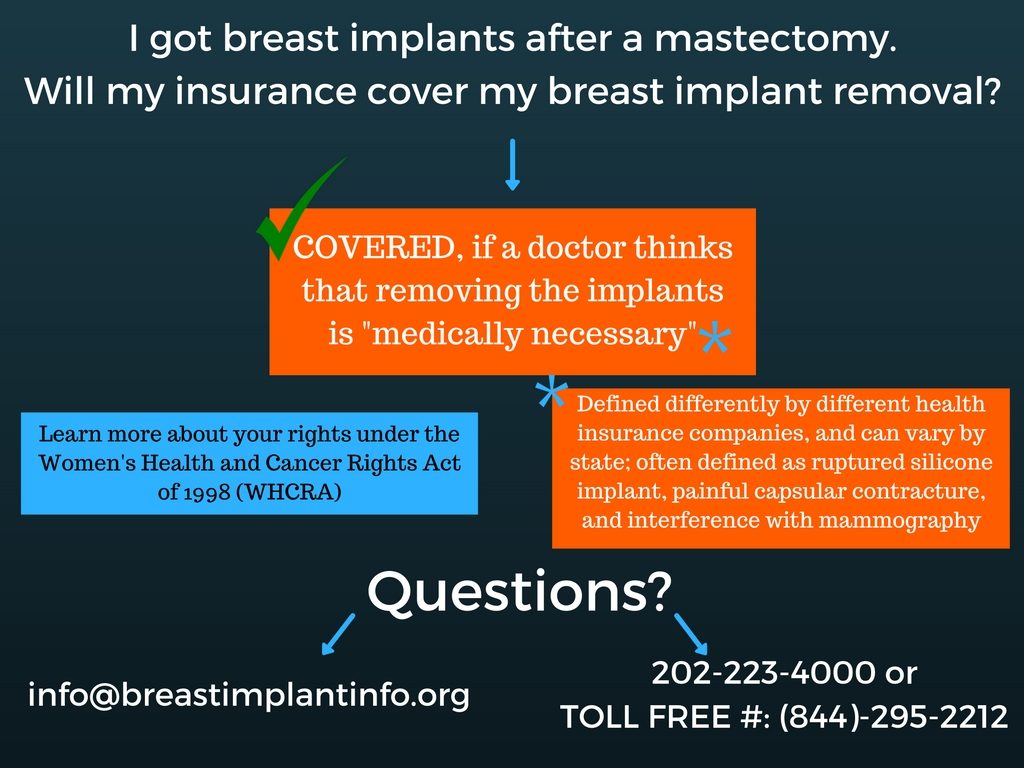
Now insurance companies are usually required to pay for “medically necessary” services. Medically necessary means that a service is required to improve your health or keep you healthy. Although some insurance companies say they do not cover services related to cosmetic surgery, many have exceptions when those services are medically necessary. It is important that you read the policies carefully before you choose!

Based on our experiences working with women having problems with their breast implants, here are some tips that might help you make a decision:

  • Many companies consider removal of breast implants medically necessary for these conditions:
    • Ruptured silicone gel breast implants
    • Severe capsular contracture
    • Infections that don’t go away
    • Chronic pain
    • ALCL (a rare cancer of the immune system)
  •  Aetna, UnitedHealthcare, and Cigna plans tend to have good coverage for medically necessary breast implant removal if you meet their criteria that include the conditions listed above.

What Should I Know Before Signing Up?

Go to www.healthcare.gov to look at the plans offered through your state. You can find pricing information for 2018 plans on the website. The lower your income, the less you’ll have to pay.

If you’ve recently lost your health insurance coverage, you can sign up through the online exchange now. You might also be able to sign up now if you’ve had a major life event, like getting married or having a baby.

Otherwise, you can sign up for health insurance between November 1 and December 15. Coverage would start January 1, 2018. If you live in California, Colorado, Minnesota, Washington, Massachusetts, or the District of Columbia, you have a few more days or weeks to sign up depending on your state [1,2,3,4,5,6]. If you live in these states or DC, you should check their deadlines and when your coverage would start.

If you get health insurance through your job or your spouse’s job, your enrollment dates might be different. You should check with your employer.

Before you buy a health insurance policy, you should ask to make sure it includes coverage for breast implant-related health problems that would qualify you for medically necessary removal. If they can’t answer your question or tell you it won’t be covered, reach out to us at info@center4research.org. We’ll do our best to help you find a better policy.

Want to know how much your health insurance plan will cost through the Affordable Care Act? Use this calculator to find out.

Is Medicaid an Option?

In many states, Medicaid is available for free to any individual or family under 133% of the poverty line (about $30,000/year for a family of 4). Medicaid provides coverage for surgery or services a doctor considers medically necessary. You can find out if you are eligible for Medicaid at www.healthcare.gov.

Read here for more information on getting Medicaid coverage for your breast implant removal surgery.

Unfortunately, fewer people are eligible for Medicaid in states that did not adopt the Medicaid expansion provided by Obamacare.

Is Medicare an Option?

If you’re over age 65, you are eligible for Medicare. You can also be eligible for Medicare if you’re under age 65 and receive Social Security Disability Insurance (SSDI) or have end-stage renal disease.

Read here for more information on getting Medicare coverage for your breast implant removal surgery.

If you’re on Medicaid or Medicare and have problems getting coverage for your breast implant problems, contact us at info@center4research.org.

References

  1. Covered California and the Department of Health Services. (2017). Open Enrollment Runs Through Jan. 31, 2018. Retrieved from https://www.coveredca.com/apply/. Accessed on November 1, 2017.
  2. The Colorado Division of Insurance and the Colorado Department of Regulatory Agencies. (2017). Open Enrollment Dates for 2018 Colorado Health Insurance Coverage Set: Nov. 1, 2017 to Jan. 12, 2018. Retrieved from https://www.colorado.gov/pacific/dora/news/open-enrollment-dates-2018-colorado-health-insurance-coverage-set-nov-1-2017-jan-12-2018. Accessed on November 1, 2017.
  3. (2017). Open Enrollment Period. Retrieved from https://www.mnsure.org/new-customers/enrollment-deadlines/open-enrollment/index.jsp. Accessed on November 1, 2017.
  4. Washington Health Benefit Exchange. (2017). Washington Health Benefit Exchange. Retrieved from https://www.wahbexchange.org/. Accessed on November 1, 2017.
  5. Commonwealth of Massachusetts. (2017). Health Insurance Open Enrollment and Waivers. Retrieved from http://www.mass.gov/anf/budget-taxes-and-procurement/oversight-agencies/health-policy-commission/patient-protection/health-insurance-open-enrollment-and-waivers.html. Accessed on November 1, 2017.
  6. DC Health Link. (2017). Open Enrollment & Renewal Deadlines. Retrieved from https://dchealthlink.com/open-enrollment. Accessed on November 1, 2017.

Are “Gummy Bear” Breast Implants the Safer Implants?

Diana Zuckerman, PhD, Madris Tomes, and Amelia Murphy, National Center for Health Research and Device Events

Based on the summary of book chapter in Breast Implants, Rene Simon (ed.), Nova Science Publishers, 2017.

Our new book chapter on breast implants explains that the 55-year history of breast implants reflects repeated efforts to improve their safety and effectiveness by reducing the cosmetic problems and health complications that develop during the years while they are in the human body. The most recent effort is the type of highly cohesive breast implants known as “gummy bear implants” because of the thick gel that is described as similar to gummy bear candies. The goal of the more cohesive gel is to make implants last longer and be less likely to leak. First approved in the United States in 2012, adverse event reports indicate that this newest generation of implants causes complications similar to older generations of silicone gel breast implants.

The first breast implants, made in the 1960’s, were for cosmetic enhancement. When women’s augmented breasts became hard over time, implant manufacturers responded by making the silicone gel thinner. One manufacturer, Surgitek, added polyurethane foam to the outside to make the breasts feel softer. Those design changes caused other problems, however: the thinner gel had a tendency to “bleed” through the silicone elastomer shell, which contributed to the most common complication, capsular contracture. Breast implants made with thinner gel also ruptured and leaked more easily, and the gel broke down into silicone oil which could migrate to other organs or cause silicone granulomas inside their bodies. The polyurethane foam caused other problems: implant removal was very difficult and women lost their breast tissue during explant surgery, and the foam was found to break down to a known carcinogen.

The Food and Drug Administration (FDA) did not require breast implant manufacturers to submit data to prove the implants were safe and effective until 1992. By that time, the manufacturers had developed implants with a thicker shell and a more cohesive silicone gel. However, the studies revealed that, like the earlier implants, the more cohesive implants did not “last a lifetime” as had been claimed. As a result, manufacturers continued to modify the silicone gel to make it less likely to rupture and leak.

Despite claims that gummy bear implants are safer than other breast implants, a 5-year study found that the rupture rate was more than 4% for first-time augmentation patients.  The percentage of women needing additional surgery within 5 years ranged from 17% to 48%, depending on whether the patients were augmentation patients or reconstruction patients, and whether the gummy bear implants replaced previous implants. Our analysis found that from January 1, 2008 through June 30, 2017, 1298 adverse event reports for silicone gel breast implants were made to the FDA, 252 (19%) of which were for gummy bear implants. This is very high when you keep in mind that gummy bear implants were relatively rare in the U.S. prior to FDA approval in 2012. This chapter puts these statistics in the context of what is known about the safety of silicone breast implants and how that has changed over time.

Copies of the entire book chapter are available upon request at info@center4research.org

Medicare Breast Implant Removal Policies by State

Click on your state (or territory) below to see it’s official Medicare policy on breast implant removal.

If your state isn’t listed, it doesn’t have its own policy. You can look at this policy, which is usually borrowed by states that don’t have their own policy.  

Alaska

American Samoa

Arizona

Arkansas

California

Colorado

Delaware

District of Columbia

Guam


Hawaii

Idaho

Indiana

Iowa

Kansas

Louisiana

Maryland

Michigan

Mississippi

Missouri

Montana

Nebraska

Nevada

New Jersey

New Mexico

North Carolina

North Dakota

Northern Mariana Islands

Oklahoma

Oregon

Pennsylvania

South Carolina

South Dakota

Texas

Utah

Virginia

Washington
Wyoming

West Virginia

Will Medicaid Pay To Remove My Breast Implants?

Medicaid is a program that pays for medical costs for people with low incomes or limited resources. It is paid for by both federal and state governments.

Each state decides exactly what services will be paid for and how much they cost. In order for implant removal or any other service to be covered, your doctor must tell Medicaid that the service is medically necessary.

Because each state has different policies, you’ll have to do some research to find out whether your implant removal surgery will be paid for in the state where you live.

Even though each state runs its own Medicaid program, there are still guidelines they have to follow. All Medicaid patients across the country are entitled to certain medical services, including prevention services and screenings.

Where to Start

  1. You should make an appointment with your primary care doctor. Under Medicaid, that doctor is your “primary care coordinator.” Your doctor will have to approve the procedure and ask Medicaid if they will cover the costs.
  2. If your primary care doctor is part of an HMO (Health Maintenance Organization), he or she will refer you to a surgeon within the HMO. You may be required to use an HMO surgeon in order for Medicaid to cover the cost. If your HMO doesn’t have a surgeon who can do the surgery, you might be referred to a surgeon outside the network.
  3. If your primary care doctor is not part of an HMO, she/he may be able to tell you which surgeons in your area will accept Medicaid patients.

If you have Medicaid and Medicare

Dual Eligible Beneficiaries

People who are enrolled in both Medicare and Medicaid are called “Dual Eligible Beneficiaries.” They are enrolled in Medicare Part A and/or Part B and receive full Medicaid benefits and assistance with Medicare premiums.

If you are dual eligible, Medicare will pay for your medical services first. Medicaid may cover the cost of care that Medicare won’t. You should speak with your primary care doctor about the specifics.

Will Medicare Pay to Remove My Breast Implants?

Medicare usually covers breast implant (saline or silicone) removal for any of these conditions:

  • Painful capsular contracture with disfigurement
  • Implant rupture
  • Infection
  • Implant extrusion (coming through the skin)
  • Interference with the diagnosis of breast cancer
  • Siliconoma or granuloma (silicone-filled lumps under the skin)

Medicare coverage can differ depending on the state where you live. You can check the specific Medicare policies on breast implants removal in your state here.

Whether or not Medicare will pay for your breast implant removal depends on many factors. Below are some questions that will help you figure this out.

Original Medicare Plan

Original Medicare means you’re enrolled in Medicare Parts A & B and don’t have a Medicare Advantage plan.

1) Is your surgeon a Medicare Participating Provider “who takes assignment?” If you aren’t sure, ask the surgeon’s office whether they “take assignment.”

  • A surgeon who “takes assignment” has agreed to accept the Medicare fee as full payment for the surgery. The surgeon must submit the claim for your surgery directly to Medicare. Your surgeon CANNOT charge you, except for the deductible and/or copay amounts that Medicare doesn’t cover. Your surgeon should call the Medicare provider line to see if your surgery will be covered.
  • Even if your surgeon doesn’t think Medicare will cover the surgery, you still should ask the surgeon’s office to call the Medicare provider line to check. Many surgeons don’t know that Medicare will cover breast implant removal, so it’s important to have them check.
  • A Medicare Participating Provider who takes assignment IS REQUIRED to submit your Medicare claim within a year of your surgery. If they don’t, Medicare won’t pay and the doctor might try to get the patient to pay. That isn’t fair, so don’t let that happen to you.
  • You can check for Medicare participating providers here.

2) Is the surgeon you are thinking of using a Medicare Participating Provider “who does NOT take assignment?”

  • A surgeon who “doesn’t take assignment” can charge you up to 115% of the Medicare-approved fee. You might be asked for full payment upfront (at the time the surgery is done).
  • A surgeon who does not usually “take assignment,” can do so on a case-by-case basis, so you should check to see if the surgeon is willing to “take assignment” from Medicare in your case.
  • A surgeon who doesn’t take assignment may not be able to submit your claim to Medicare. You should ask the surgeon’s office who will be responsible for filing your claim. If the surgeon agrees to file, you should check to make sure it is filed soon. IMPORTANT: If it is not filed within one year of your surgery, Medicare will NOT pay the claim and you may be liable for the entire amount.
  • If your surgeon won’t submit your claim to Medicare, you can fill out this form for reimbursement with Medicare.

3) Has the surgeon you plan to use “Opted Out” of Medicare?

  • Surgeons who have “opted out” of Medicare don’t take assignment, submit Medicare claims, or limit fees to the Medicare-approved fee amounts.
  • Surgeons who have “opted out” of Medicare are REQUIRED to notify the patient with a written contract. This contract confirms that a patient understands she is directly responsible for paying the surgeon whatever he or she charges and that she CANNOT seek reimbursement from Medicare.

4) Do you have a supplemental insurance plan in addition to your Medicare coverage?

  • A supplemental plan might cover the deductible and/or copay amounts.
  • Medicare is your primary insurance and will reimburse the surgeon. You will need to get approval from Medicare BEFORE going to your supplemental plan.

Medicare Advantage Plan

1) Are you enrolled in a Medicare Part C Advantage Plan?

2) Is your surgeon part of your Plan network? If you are unsure, ask your Plan.

Because Medicare Part C Advantage Plans deal with Medicare directly, you won’t have to submit a claim to Medicare.

If your surgeon is NOT in your Plan network of providers, you may have to submit a claim directly to your Plan, Your Plan may limit what they will pay for your surgery. IMPORTANT: To avoid unplanned expenses, check with your Plan BEFORE you schedule surgery with a surgeon who is outside your Plan network.

3) Does your Plan require that you get pre-approval for your surgery and, if so, have you received pre-approval?

Most plans require that you get permission from your Plan before the surgery. If you don’t get pre-approval, the Plan might not cover your surgery.

Are you on Medicare and Medicaid?

People who are enrolled in both Medicare and Medicaid are called “Dual Eligible Beneficiaries.” They are enrolled in Medicare Part A and/or Part B and receive full Medicaid benefits and assistance with Medicare premiums.

If you’re dual eligible, your medical services generally are usually paid at the Medicare-approved amount. Because it depends on your unique situation, you should speak to your primary care doctor about the specifics.

Breast implants after mastectomy: Risks you need to know

Diana Zuckerman, Ph.D.
Updated 2017

The complication rate for getting breast implants after mastectomy has been described by experts as “alarmingly high and arguably unacceptable,”1 even though most of the information about complications is based on studies that were paid for by companies that make breast implants or silicone.

How safe are breast implants and how many women have complications after getting reconstruction with breast implants after a mastectomy? When the Food and Drug Administration (FDA) approved breast implants, they acknowledged that the complication rate is very high for all women, especially those undergoing reconstruction after a mastectomy. What the FDA did not know, however, is that early-stage breast cancer patients that undergo mastectomy and reconstruction with breast implants are 10 times as likely to commit suicide as other early-stage breast cancer mastectomy patients.

Complications from Implants

We do not know why the suicide rate is so high for mastectomy patients with breast implants, but we do know that complications are very common. For example, a study conducted by implant manufacturer Inamed (now called Allergan) found that 46% of reconstruction patients needed additional surgery within the first 2 to 3 years after getting silicone gel breast implants 2. Not surprisingly, the implant maker did not publish an article describing this high complication rate, which was more than twice as high as the 21% reported in a study funded by a company that makes silicone (Dow Corning).1

Why was the complication rate lower in the Dow Corning study? One explanation is that the women in that study had breast implants for an average of only 23 months, compared to 2-3 years in the Inamed study. Even so, the Dow study found that 31% of the women developed at least one serious complication and 16% developed at least 2 serious complications in that short period of time. The Inamed study reported that 25% underwent implant removal, 16% experienced Baker III-IV capsular contracture (which is painful breast hardness), 6% experienced necrosis (death of breast tissue), 6% had other types of breast pain, and 6% had an implant that ruptured, and other women reported infections and other complications.2  This shows that both studies found very high complication rates despite a short follow-up of less than 3 years.

The Dow-funded study concluded that “reconstruction failure (loss of implant) is rare.” Of course, it should be rare after less than 2 years. In contrast, when Inamed used Magnetic Resonance Imaging (MRIs) to detect rupture, they found that 20% of reconstruction patients had ruptured implants by the third year;3 but very few ruptures were detected without MRIs. Since Henriksen did not use MRIs. Since the Dow Corning study did not use MRIs to detect rupture, they couldn’t accurately count the number of failed implants.  Moreover, FDA scientists concluded that the risk of rupture would likely increase exponentially every year.4

Many plastic surgeons claim that the Institute of Medicine concludes that breast implants are safe. However, the Institute of Medicine report was completed in 1999, years before most research was conducted. Most research on breast implant patients was published after 1999, making the report very outdated. Many of the studies reported higher levels of diseases or symptoms among women with breast implants, which would have reached statistical significance if the studies were larger and women were followed for a longer period of time.

Can implants cause cancer or other serious diseases?

Experts around the world now agree that breast implants can cause a type of cancer of the immune system called ALCL (anaplastic large cell lymphoma).  In fact, there is now a specific diagnosis called breast implant associated ALCL (BIA-ALCL).  If caught early, removal of the breast implants can be very effective, but if not treated quickly it can be fatal. 5

The link between breast implants and other cancers remains controversial.  Studies paid for by plastic surgeons or implant companies tend to conclude that breast implants are safe. Since breast implants can cause cancer of the immune system, it seems logical that implants might have an impact on other diseases of the immune system or other cancers.  For example, FDA scientists reported a significant increase in fibromyalgia and several other autoimmune diseases among women whose silicone gel breast implants were leaking, compared to women with silicone implants that were not leaking outside the scar tissue capsule.4 In addition, scientists at the National Cancer Institute (NCI) found a doubling of deaths from brain cancer, lung cancer, and suicides among women with breast implants compared to other plastic surgery patients.6 National Cancer Institute scientists concluded that more research was needed to determine if implants increase the risk of cancer or autoimmune diseases.5,6

The Bottom Line

Many women choose mastectomies to “get rid of the cancer once and for all” hoping that it is the safest strategy for dealing with breast cancer.  However, research shows that women who have lumpectomies live longer than women with the same diagnoses that chose mastectomies instead. Research makes it clear that there are many complications from breast implants that often keep women needing additional surgery and medical help in the years after breast cancer is removed, including the possibility of cancer of the immune system.  Unfortunately, many women tell us that their doctors did not warn them about these risks. [Read a New York Times article about a woman with ALCL here.]

Some of the information from this article was based on Dr. Zuckerman’s article published in Archives of Surgery, Vol 141, pages 714-715. The original article can be found here.

Are Mastectomies Necessary for Women with BRCA1 or BRCA2? What About for Women Without the Breast Cancer Gene?

Diana Zuckerman, PhD, and Megan Polanin, PhD, National Center for Health Research

When Angelina Jolie publicly announced her double mastectomy in 2013, she was praised for possibly saving many women’s lives. But we know more today than we did then and experts now agree that too many women are undergoing unnecessary mastectomies. Here are the facts.
A review of 10 studies found that the risk of getting breast cancer for an average woman with BRCA1 is 57%. The risk is 49% for a woman with BRCA2.[1] Keep in mind that for younger women, the lifetime risk of breast cancer is very different from the risk of getting breast cancer in the next 10 years or even 20 years. According to experts, a 40-year-old woman with the BRCA1 gene has a 14% chance of getting breast cancer before she turns 50.[2] That is not nearly as frightening, and with regular screening and all the progress in breast cancer treatments, the survival rate from breast cancer is higher than ever. Many breast cancer patients live long and healthy lives.
Most women are diagnosed with breast cancer at early stages, making it safe to undergo a lumpectomy (which removes just the cancer) rather than a mastectomy (which removes the entire breast). Yet American women are undergoing prophylactic mastectomies at a higher rate than women in other countries — many of them medically unnecessary.[3] Breast cancer experts believe that many women undergoing mastectomies do not need them and are getting them out of fear, not because of the actual risks.
In recent years, we have seen an increase in women with early-stage breast cancer choosing to get a double mastectomy. For example, a 2015 study conducted by researchers at Vanderbilt University reported that, for women diagnosed with early-stage breast cancer in one breast, the rates of double mastectomy increased from 2% to 11% from 1998 to 2011.[4] Researchers found that decisions to have a double mastectomy increased more for two groups of women: 1) Women with ductal carcinoma in situ (DCIS) where there are abnormal cells inside a milk duct in the breast that won’t spread and aren’t dangerous and 2) Women with cancer only in the breast that has not spread to the lymph nodes.
This year, researchers from Emory University and colleagues published a study focused on women diagnosed with early-state breast cancer in one breast.[5] They found that, from 2004 to 2012, the percentage of these women 45 years or older who got double mastectomies more than doubled from 4% to 10%. For women ages 20-44, the percentage tripled from 11% to 33%. Researchers found that it mattered where women lived in the United States. For example, in five Midwestern states (Nebraska, Missouri, Colorado, Iowa, and South Dakota), 42% of the women who got surgery decided to get a double mastectomy.
For many years, experts have known that women who undergo lumpectomies for a non-invasive condition called ductal carcinoma in situ (DCIS) or for early-stage breast cancer live just as long as women undergoing mastectomies. However, the latest research goes a step further: a study conducted in the Netherlands of more than 37,000 women with early-stage breast cancer found that the women undergoing lumpectomies were more likely to be alive 10 years later than women with the same diagnosis who underwent a single or double mastectomy.[7] They were also less likely to have died of breast cancer.
In 2016, Harvard cancer surgeon Dr. Mehra Golshan published a study of almost half a million women with breast cancer in one breast. She reported that those undergoing double mastectomies did not live longer than women undergoing a mastectomy in only one breast.[6]
These are just the most recent studies. For more information about the many studies that show the benefits of less radical surgery, see this article.
The bottom line is that women with DCIS or early-stage breast cancer have more effective and less radical treatment options than mastectomy. We need to stop thinking of mastectomy as the “brave” choice and understand that the risks and benefits of mastectomy are different for every woman with cancer or the risk of cancer. In breast cancer, any reasonable treatment choice is the brave choice.
The research clearly shows that mastectomies are not the best choice for most women if they want to live longer. Women should be aware of treatment choices for breast cancer and encouraged to make decisions based on their own unique situations. For each woman, it is important to weigh her own risk of cancer — in the next few years, and not just over her lifetime – and the risks of various treatments. Each woman should make the decision that is best for her, based on the facts, not on fear.

All articles are reviewed and approved by Dr. Diana Zuckerman and other senior staff.
1. Chen, S., & Parmigiani, G. (2007). Meta-analysis of BRCA1 and BRCA2 penetrance. Journal of Clinical Oncology, 25(11), 1329-1333.
2. Chen, S., Iversen, E. S., Friebel, T., Finkelstein, D., Weber, B. L., Eisen, A., … & Corio, C. (2006). Characterization of BRCA1 and BRCA2 mutations in a large United States sample. Journal of Clinical Oncology, 24(6), 863-871.
3. Metcalfe, K. A., Birenbaum?Carmeli, D., Lubinski, J., Gronwald, J., Lynch, H., Moller, P., … & Kim?Sing, C. (2008). International variation in rates of uptake of preventive options in BRCA1 and BRCA2 mutation carriers. International journal of cancer, 122(9), 2017-2022.
4. Kummerow, K. L., Du, L., Penson, D. F., Shyr, Y., & Hooks, M. A. (2015). Nationwide trends in mastectomy for early-stage breast cancer. JAMA surgery, 150(1), 9-16.
5. Nash, R., Goodman, M., Lin, C. C., Freedman, R. A., Dominici, L. S., Ward, K., & Jemal, A. (2017). State variation in the receipt of a contralateral prophylactic mastectomy among women who received a diagnosis of invasive unilateral early-stage breast cancer in the United States, 2004-2012. JAMA surgery.
6. Wong, S. M., Freedman, R. A., Sagara, Y., Aydogan, F., Barry, W. T., & Golshan, M. (2017). Growing use of contralateral prophylactic mastectomy despite no improvement in long-term survival for invasive breast cancer. Annals of surgery, 265(3), 581-589.
7. van Maaren, M. C., de Munck, L., de Bock, G. H., Jobsen, J. J., van Dalen, T., Linn, S. C., … & Siesling, S. (2016). 10 year survival after breast-conserving surgery plus radiotherapy compared with mastectomy in early breast cancer in the Netherlands: a population-based study. The Lancet Oncology, 17(8), 1158-1170.
8. Hwang, E. S., Lichtensztajn, D. Y., Gomez, S. L., Fowble, B., & Clarke, C. A. (2013). Survival after lumpectomy and mastectomy for early stage invasive breast cancer. Cancer, 119(7), 1402-1411.
9. Kurian, A. W., Lichtensztajn, D. Y., Keegan, T. H., Nelson, D. O., Clarke, C. A., & Gomez, S. L. (2014). Use of and mortality after bilateral mastectomy compared with other surgical treatments for breast cancer in California, 1998-2011. JAMA, 312(9), 902-914.